About Hunnemannia fumariifolia Sweet
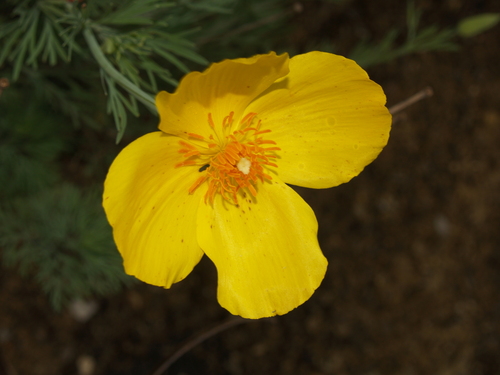
Hunnemannia is a monotypic genus of flowering plants in the poppy family Papaveraceae, which contains only one species: Hunnemannia fumariifolia, commonly called tulip poppy or Mexican tulip poppy. This species is native to the highlands of Mexico. It typically grows at elevations between 1,500 and 2,000 m (4,921–6,562 ft), ranging from the Chihuahuan Desert south into central Mexico. It favors rocky habitats, and can also be found growing along roadsides. Hunnemannia fumariifolia is a perennial plant with erect stems that are somewhat woody at the base, and can reach up to 60 cm (24 in) in height. Its leaves resemble those of the closely related genus Eschscholzia, and are finely divided into many gray-green linear lobes. The flowers are solitary yellow cup shapes formed from four overlapping petals, measuring 5–7 cm across. They vaguely resemble tulips, which are not closely related to this species. As the flower opens, the two sepals underneath typically fall away. The numerous stamens are short, with orange anthers. The long, thin fruits of this species are also similar in appearance to fruits of Eschscholzia. The genus Hunnemannia is named for John Hunnemann (1760-1839), an English botanist and plant collector. The specific epithet fumariifolia is Latin, and literally means "with leaves like Fumaria" (fumitory). Hunnemannia fumariifolia is widely cultivated, most often grown as an annual from seed. In colder climates, it requires shelter from a south-facing wall, and grows best in full sun. The cultivar 'Sunlite' has received the Royal Horticultural Society's Award of Garden Merit.