About Humulus scandens (Lour.) Merr.
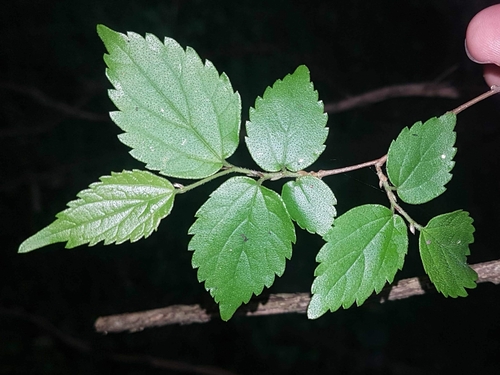
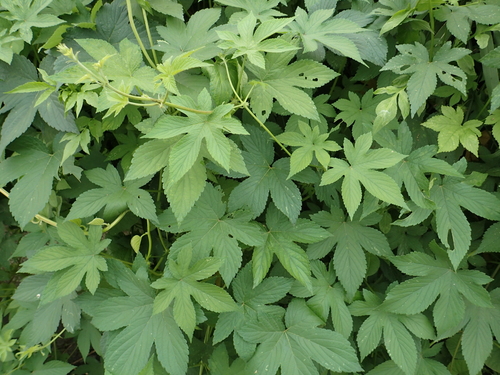
Well-developed leaves of Humulus scandens have 5 to 9 lobes. The abaxial surfaces of these leaves are pubescent, but not densely so. Its infructescence is rarely longer than 2 cm, with bracts and bracteoles less than 1 cm long, and distinctly spinulose-ciliate. Staminate inflorescences are erect and measure 15–25 cm, and flower anthers do not have glands. Pistillate inflorescences are spiked, conelike, and ovoid; bracteoles are ovate-orbiculate, 7–10 mm, pilose, with densely ciliate-hairy margins. Infructescences are pendulous, green, conelike, and ovoid to oblong, measuring (1–)1.5–3(–4) cm; bracteoles do not have yellow glands. This species, often referred to as Humulus japonicus, is native to temperate regions of Asia, including China, Japan, Korea, Taiwan, and the Russian Far East, as well as the tropical environments of Vietnam and Laos. It was imported to North America in the late 19th century, and has since become an invasive species there. It has become highly successful across the continent, and is found throughout eastern Canada and the eastern half of the United States. In the United States, its range extends west from Nebraska and North Dakota to Maine, and south from Minnesota to Georgia. Japanese hops (the common name for this plant) grow well in conditions with abundant sunlight, moisture, and nutrient-rich soil. They are most commonly found growing along stream banks and floodplains. They grow less well in shaded areas and drier soils, and can survive winter in milder climates. This plant was introduced to North America in the 19th century both as an ornamental plant and as a raw ingredient for Asian tonics. In traditional Chinese medicine, this herb, known as lü cao, is used rather uncommonly, and is said to have diuretic and heat-cooling effects. While it is related to the common hop Humulus lupulus, whose cultivars are brewer's hops used in beer production, Japanese hop lacks the bitter acids and essential oils used to flavor beer, and is either devoid of lupulin glands or produces very few resin glands. For this reason, Japanese hop is not considered a viable option for brewing use.