About Hulsea algida A.Gray
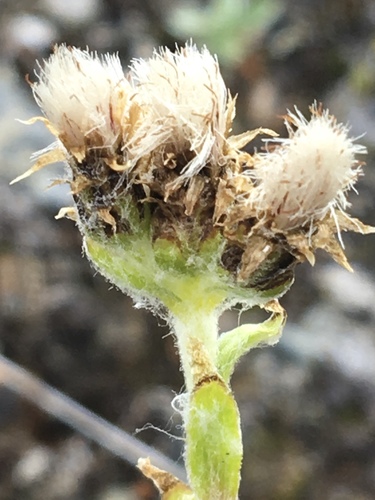
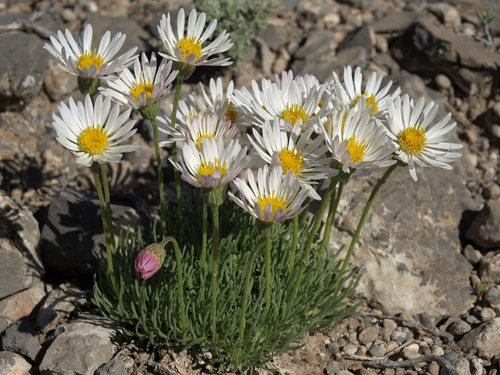
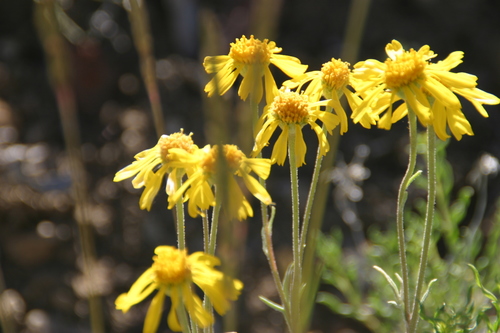
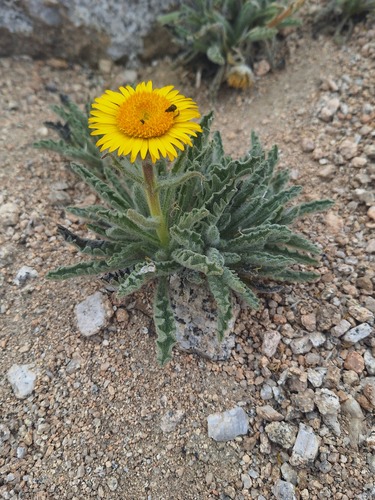
Hulsea algida A.Gray, or H. algida, is a hairy, glandular perennial herb that grows stout, erect stems reaching close to 40 centimeters (16 inches) tall. Its narrow dark green leaves are covered in white hairs, with wavy, toothed edges. Most leaves form a thick clump at the base of the plant, where they can grow up to 15 cm (6 in) long, while a smaller number grow directly from the stems. Flower heads (called pseudanthia) bloom from July to September. Each flower head is wrapped in a cup of densely woolly reddish-green phyllaries, which open to reveal a daisy-like bloom 5–9 cm (2–3½ inches) wide. The center of the bloom holds yellow or orange disc florets, and the outer edge has up to 60 bright yellow or gold ray florets. Each ray floret is about 1 cm long, with a rounded or toothed tip. The fruit of the plant is an achene up to 1 cm long, tipped with a pappus that may be longer than the achene itself. Hulsea nana is a similar species, but it rarely grows more than 10 cm (4 in) tall, has a leafless stalk, and only produces 21 ray flowers per pseudanthium. H. algida is native to California, Oregon, Nevada, Idaho, Montana, and Wyoming in the United States. In California, it grows in the Sierra Nevada and the White Mountains. It occurs at elevations between 2,900 and 4,300 metres (9,500 and 14,000 feet), in alpine and subalpine talus habitats.