About Hulodes caranea (Cramer, 1780)
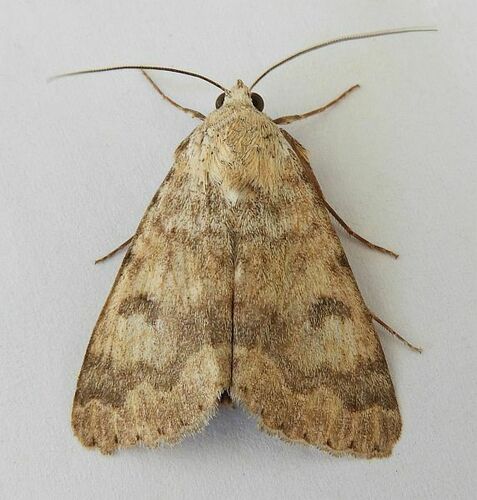
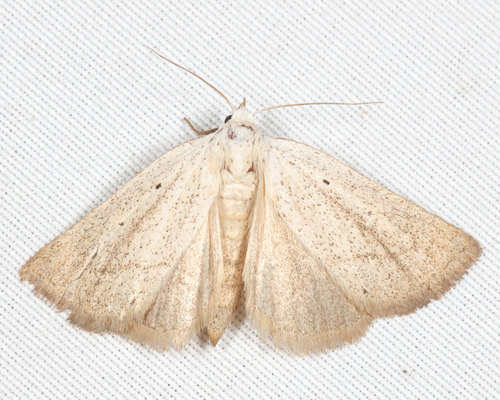
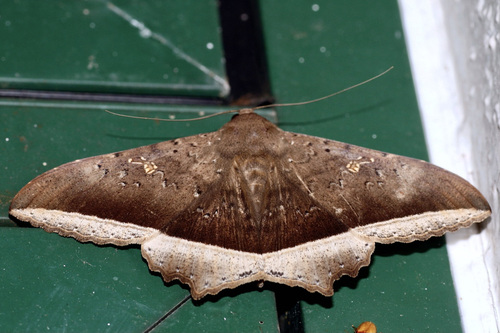
Hulodes caranea has a wingspan that measures approximately 84–90 mm. The outer margin of its hindwings is crenulate, and forms a pointed projection at vein 4. Males are fuscous brown. Their wings are suffused with purple color extending out to the curved submarginal line, which runs from the apex to the inner margin of the hindwings; the area beyond this line is ochreous brown, and marked with a series of specks along the margin. The forewings have faint traces of waved antemedial and postmedial lines, plus an ochreous lunule centered with brown at the end of the cell. The hindwings have faint traces of a waved antemedial line. On the ventral side, there is a crenulate medial line. Ventrally, the hindwings bear a black cell spot and an additional black spot at the middle of the costa. Females are pale ochreous brown, with some dark brown suffusion inside a double oblique line. The larva of Hulodes caranea is olive greenish with fuscous speckles, and is paler on its underside. It has two pointed dorsal tubercles on the anal somite. Streaks arranged in dorsal and lateral black bands, plus greenish white blotches, are present on its back and sides. Its stigmata are black, and its tubercles are reddish. The larvae feed on species from the plant families Acanthaceae and Apocynaceae.