About Huernia schneideriana A.Berger
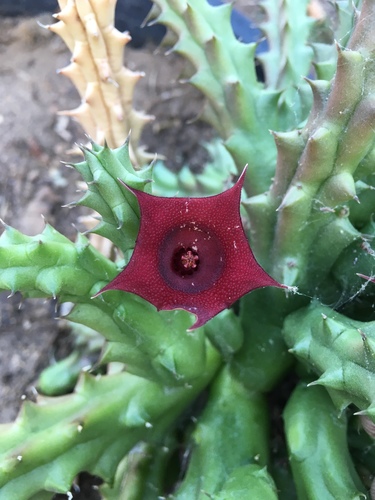
Huernia schneideriana grows in clumps, with smooth, four-sided stems that range in color from green to reddish based on how much sun exposure they receive. These stems are normally 2 to 6 inches (51 to 152 mm) long, but can reach up to 30 inches in length. They are edged with soft, tooth-like tubercles that are rigid but not very sharp. The small, funnel-shaped flowers grow on short stalks from the base of the stems. They are most often dark crimson or burgundy, with a velvety texture, and frequently feature a darker ring in their center. The flower petals are fused together at the base to form the funnel shape before spreading outwards. A distinct feature of this species’ flowers is that they do not produce the rotting-meat scent that is characteristic of many other Huernia species, which rely on flies and beetles for pollination. The most common use of Huernia schneideriana is as an ornamental decorative plant. It makes an ideal houseplant for bright indoor spaces, and can be grown outdoors in USDA hardiness zones 9 through 11, where climate conditions are suitable. Its unusual stems and flowers make it a striking conversation piece, and it is a popular addition to succulent plant collections. It has been reported that in the native range of some Huernia species, stems were boiled and eaten as a famine food. This is not a common or recommended practice for Huernia schneideriana, because the plant is uncommon and low in nutrients.