About Hubera nitidissima (Dunal) Chaowasku
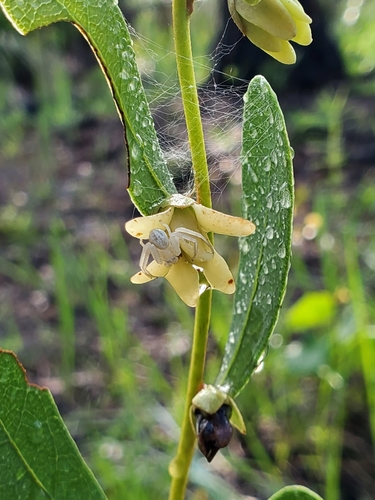
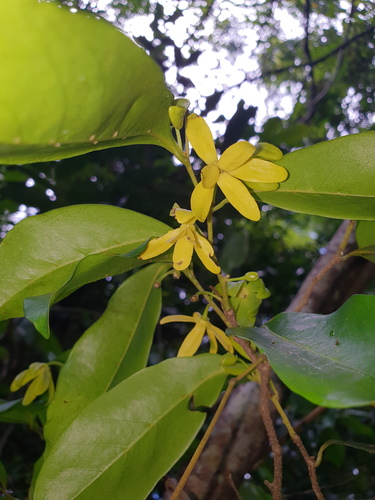
Hubera nitidissima (also referred to as Huberantha nitidissima, common name canary beech) is an understorey shrub or small tree that grows up to around 12 m (39 ft) tall. Its leaves are ovate to elliptic, reaching up to 11 cm (4.3 in) long and 5 cm (2.0 in) wide. Each leaf has 6–9 pairs of lateral veins on either side of the midrib; the upper leaf surface is shiny dark green, while the underside is lighter in color. Domatia, in the form of tufts of hairs, are often present on the leaves. Flowers grow singly or in pairs. The green sepals are about 2 mm (0.08 in) long, and there are six yellow petals arranged in two rows of three, each petal measuring about 20 mm (0.79 in) long. The fruit is a botanical berry around 10 mm (0.39 in) long and 9 mm (0.35 in) wide, which may be yellow, orange, or red, and contains a single brown seed. This species is found in the Top End of the Northern Territory, across the northernmost part of Cape York peninsula, along the entire east coast of Queensland extending south to northeastern New South Wales. It has also been recorded in the southern part of New Guinea adjacent to Cape York, as well as in New Caledonia and Vanuatu in the Coral Sea. It grows in drier rainforest types including monsoon forest and beach forest. In north Queensland, it occurs at altitudes ranging from sea level up to around 800 m (2,600 ft). Ecologically, Hubera nitidissima acts as a host plant for the larvae of three butterfly species: the green spotted triangle, the green triangle, and the pale green triangle. Pigeons eat the fruit of this species.