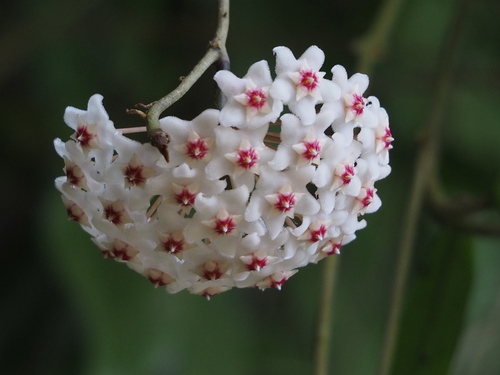
About Hoya carnosa (L.fil.) R.Br.
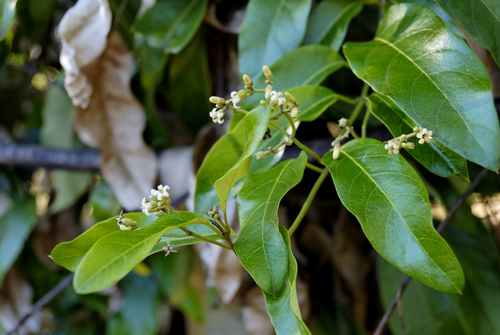
Hoya carnosa (L.fil.) R.Br. produces faintly succulent shoots that have smooth, pale gray, bare surfaces, and grow by twining and climbing. Its perennial leaves range from broadly oval, to elongated oval, to heart-shaped. The leaves are slightly succulent and fleshy, with a waxy glossy surface; they measure 3–5 centimetres (1.2–2.0 in) wide and 3.5–13 centimetres (1.4–5.1 in) long, with a petiole around 1–1.5 centimetres (0.39–0.59 in) long. Its spindle-shaped fruits are 6 to 10 cm long and 0.5 to 1.5 cm wide. Hoya carnosa is native to southern China (including Hainan), Taiwan, Laos, and Japan (including the Ryukyu Islands). In cultivation, Hoya carnosa prefers indirect bright light, but can tolerate far lower light levels. While it can withstand low non-freezing temperatures, its optimal growing temperature range is 60–85 °F (16–29 °C). It can be propagated via air layering or stem cuttings. It grows best in an open potting medium that lets air reach the roots; common mixes include large-grade drainage materials such as perlite, pumice, or ceramic balls. Plants should be fed regularly with a fertilizer made for epiphytic plants. A common persistent belief holds that hoyas prefer being pot-bound, kept in a small pot, and that this encourages earlier flowering. A 2009 study from the University of Georgia found H. carnosa is excellent at removing indoor environmental pollutants.