About Hoya australis R.Br. ex J.Traill
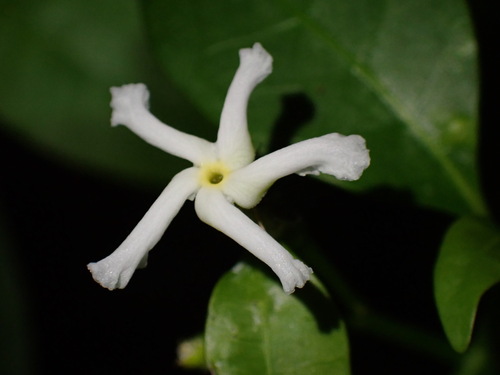
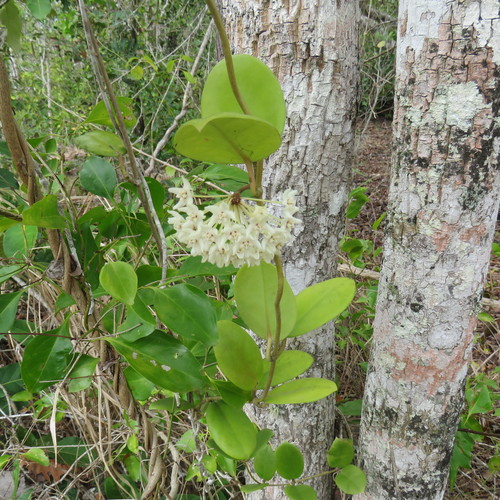
Hoya australis R.Br. ex J.Traill is a succulent plant that grows as either a climbing vine or a subshrub, and typically reaches a height of 4–10 m (13–33 ft). It has fleshy or leathery leaves that can be elliptic, oblong, egg-shaped, or roughly round. Leaves grow up to 150 mm (5.9 in) long and 120 mm (4.7 in) wide; leaves in sunnier locations are yellowish green, while leaves in shadier spots are dark green. Its flowers are arranged in racemes 10–25 mm (0.39–0.98 in) in diameter. Each individual flower is 3–5 mm (0.12–0.20 in) long, and grows from a pedicel 20–40 mm (0.79–1.57 in) long. The flowers are fleshy, shaped from bell-like to wheel-like, and cream-coloured with red colouring under the corona. They have egg-shaped lobes that are 4–8 mm (0.16–0.31 in) long and 4–6 mm (0.16–0.24 in) wide. The flowers have a strong sweet scent and produce large amounts of nectar. The corona lobes are oval, cream-coloured, 1.2–3.5 mm (0.047–0.138 in) long and 1.0–2.5 mm (0.039–0.098 in) wide. Flowering time varies between subspecies, and the fruit is a spindle-shaped follicle 90–130 mm (3.5–5.1 in) long. This Hoya species is endemic to Australia, where it occurs in Western Australia, the Northern Territory, Queensland, and New South Wales. Subspecies australis grows in eastern Australia, from the Torres Strait in northern Queensland to Dorrigo in New South Wales. Subspecies oramicola is only found on Melville and Bathurst Islands, north of Darwin. Subspecies rupicola grows in the Kimberley region of Western Australia and the Top End of the Northern Territory, on sandstone outcrops and cliffs. Subspecies sanae grows in foreshore vine thickets on Cape York Peninsula and several offshore islands. Subspecies tenuipes is found on the southern Cape York Peninsula as far south as Innisfail, and also occurs in New Guinea, the Solomon Islands, and Melanesia. Ecologically, Hoya australis is a food plant for caterpillars of two Queensland butterflies: the no-brand crow (Euploea alcathoe) and the common Australian crow (Euploea core). Its flowers are pollinated by the southern grass-dart (Ocybadistes walkeri). In horticulture, Hoya australis is a popular garden and houseplant in Australia. It flowers best when grown in a well-lit position, and is often grown in containers. It is commonly trained to grow on trellises along verandahs, on fences, and inside glasshouses. In gardens, it attracts butterflies. It can be grown indoors as long as it receives direct sunlight.