About Hovea montana (Hook.f.) J.H.Ross
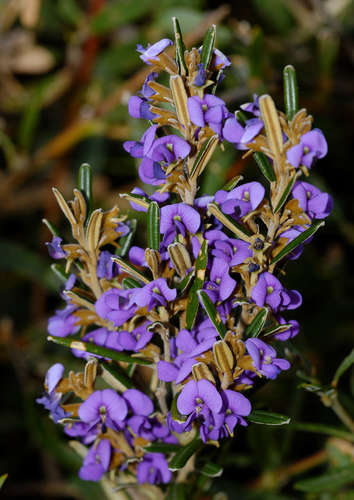
Hovea montana is a small, low-growing shrub that typically reaches 15–40 cm in height and 1–1.5 m in diameter. Its stems and branches are densely covered in soft, loosely flattened hairs. The leaves are narrow-elliptic in shape, usually 1–3 cm long and 2–5 mm wide, with a depressed midrib and margins that curve downward. The upper leaf surface is smooth and hairless, while the lower leaf surface is thickly covered with fine, soft hairs. This species produces purple-blue or white flowers, which grow singly or in pairs. Each flower is about 10 mm long, borne on a peduncle approximately 2 mm long. The calyx measures 4–5 mm long and is covered in short, matted rusty-coloured hairs. Flowering takes place from October to December. The fruit is a pod around 10 mm long, densely covered in rusty-coloured hairs. Hovea montana, also commonly called alpine rusty-pods, occurs mainly in open heath, woodlands, and grassy habitats at higher altitudes in the Australian states of New South Wales, Victoria, and Tasmania.