About Houttuynia cordata Thunb.
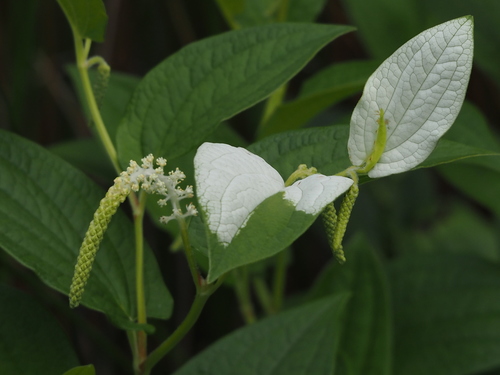
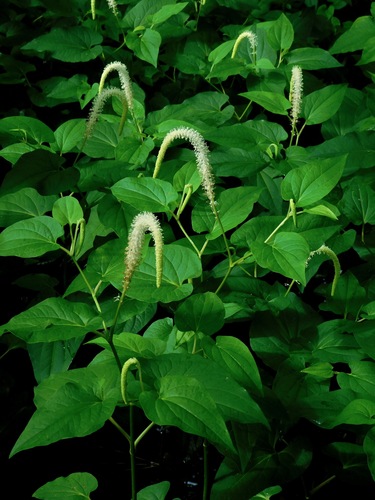
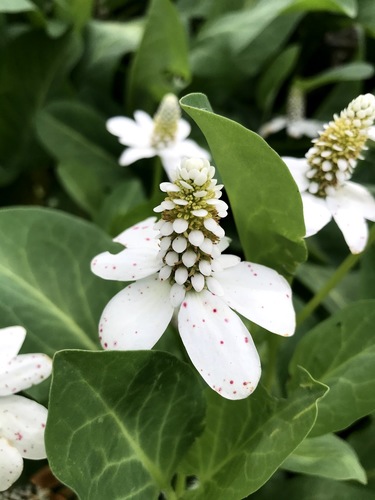
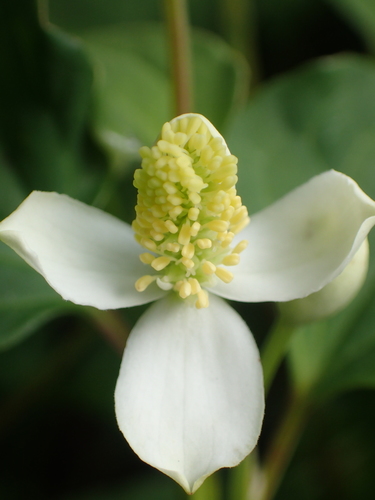
Houttuynia cordata (scientific name Houttuynia cordata Thunb.) has many common names, including fish mint, fish leaf, rainbow plant, chameleon plant, heart leaf, fish wort, and Chinese lizard tail. It is one of only two species in the genus Houttuynia, with the other being H. emeiensis. This flowering plant is native to Southeast Asia, where it grows naturally in moist, shady locations. It was named after Martinus Houttuyn. Its native distribution covers Nepal, Taiwan, Myanmar, Bhutan, India, Indonesia, Japan, China, Thailand, Vietnam and Korea. In South Korea specifically, it grows in Gyeongsangbuk-do, Ulleungdo, and the country's Southern region. For cultivation, Houttuynia cordata grows in moist to wet soil or slightly submerged in water, as long as it gets partial or full sun exposure. It can become invasive in garden settings and is difficult to remove, because its deep roots spread actively. It reproduces through division. In temperate gardens, it is most often grown in one of its cultivated forms. The 'Chameleon' variety, which is also known by the synonyms H. cordata 'Court Jester', 'Tricolour', and 'Variegata', grows less vigorously than the original parent species, and has stubbier leaves mottled with both yellow and red. Another common cultivated variety, 'Flore Pleno', produces masses of white bracts and keeps the same growth vigor as the parent species. Houttuynia cordata has become naturalized in North America. As a culinary plant, it is commonly grown as a leaf vegetable, and used as a fresh herbal garnish. Its unusual, often described "fishy" taste comes from the volatile oil decanoyl acetaldehyde (3-oxododecanal), which gave it the common nickname "fish mint". In northeastern India, the leaves are commonly used in salads, salsas, or cooked with other vegetables, and served as a garnish for side dishes. The tender roots can also be ground into chutneys alongside dry meat or fish, chilies, and tamarind. It is eaten raw in salads, and cooked with fish to make fish curry. In Japan and Korea, the dried leaves may be used to make an herbal tea. In Japan this tea is called dokudami-cha (どくだみ茶), and in Korea it is called eoseongcho cha (어성초차). In Vietnamese cuisine, the plant is called diếp cá, and is used with grilled meat and noodle salad dishes. Fish mint is also used as a garnish for multiple Vietnamese dishes, including gỏi cuốn, stir-fried beef with fish mint salad, and bánh xèo. In Chinese, the edible rhizome of Houttuynia cordata is called Zhé'ěrgēn (折耳根, "broken ear-root"), while the whole plant is called yúxīngcǎo (魚腥草, "fish-smelling grass"). The rhizome has a fresh, spicy, peppery flavour, and is used in the cuisine of southwestern China, specifically Guizhou, Sichuan, Yunnan and western Guangxi. Typically, leaves are eaten in Sichuan, while the root is eaten in Guizhou. Zhé'ěrgēn fried with larou (cured pork belly) is one of the staple dishes of Guizhou. It is also part of the wide range of fried rice dishes from Guizhou, used as a condiment for migan and mixian noodles served in broth, added as an ingredient to dipping sauces for the traditional barbecued tofu from Shiping and Jianshui, and eaten raw in cold-tossed salads, where it is most often combined with coriander, vinegar, fresh chilli, and soy sauce. In traditional Chinese medicine, Houttuynia cordata has been used, including by Chinese scientists in attempts to treat SARS and various other disorders. As of 2018, there is no high-quality clinical research to confirm that these uses are safe or effective. When H. cordata is administered through injection, it can cause severe allergic reactions.