About Hoslundia opposita Vahl
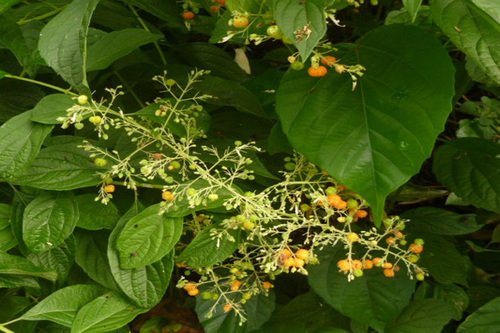
Hoslundia opposita Vahl is a spreading, erect or subscandent shrub-like perennial herb that reaches 3–4 m in height, and it often regenerates and flowers after fires. Its stems and branches are sharply 4-angled, with branches arranged oppositely. Leaves have a strong, rather unpleasant odor; they are petiolate, opposite or sometimes ternate. The leaf blade is grey-green, shaped ovate-lanceolate to ovate-elliptic, measuring 35-70 mm long by 18-25 mm wide, with an acute apex, cuneate base, velvety texture and serrated margin. Leaf petioles are short. Flowers grow in terminal, rather lax panicles or racemes. The calyx is 5-toothed, 4 mm long at flowering; its teeth are narrow, around 1 mm long, and its tube is cylindric, becoming globose and fleshy when the plant produces fruit. The corolla is bilabiate, colored white or cream, 6–7 mm long; its tube is straight and subcylindric. The upper lip is short, erect, 1 mm long, and 3-lobed, while the lower lip is spreading and slightly longer. Ripe fruit are fleshy, ovoid, ribbed, and bright orange; they are edible and favored by birds. This species is widespread across tropical Africa, ranging from Senegal to Eritrea and Somalia, extending south through the continent to South Africa, and is also found in Madagascar.