About Hortophora transmarina (Keyserling, 1865)
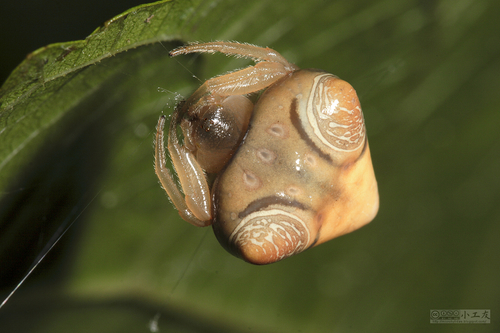
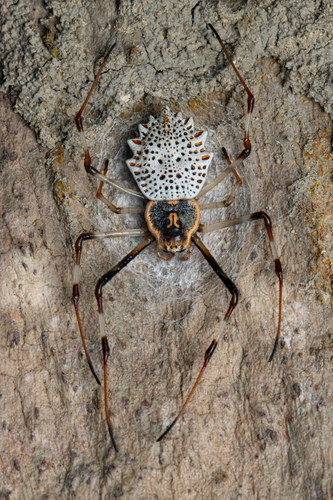
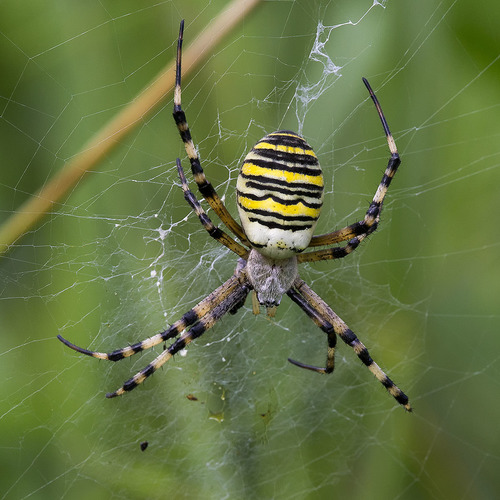
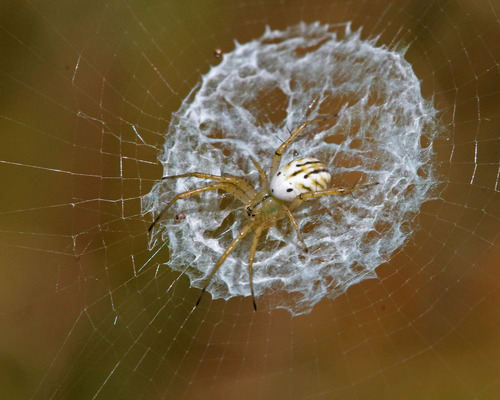
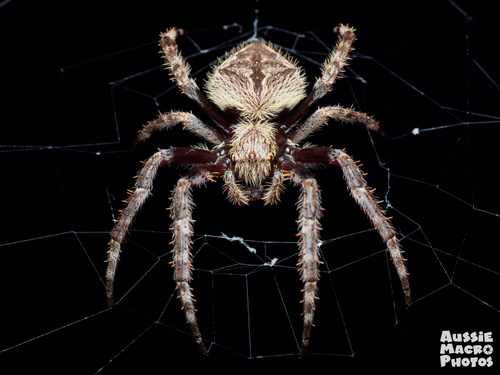
The Australian garden orb weaver spider, scientifically named Hortophora transmarina, is a very common species. It has many variants in size, shape, and colour across the coastal and northern regions of Australia. When well-fed, these spiders have very large abdomens, and show a tremendous colour range that extends from off-white through tan and brown to almost black. A roughly leaf-shaped pattern with a complex darker outline sits on the top of the abdomen, against a lighter surrounding area. The abdomen may also have several whitish spots, or one or more stripes. The spider's cephalothoraxes (heads) and proximal (closer to the body) leg segments are usually darker, and are mostly reddish or reddish brown. These spiders can change their colour with each moult to better match the background they rest on during the day. This species is notable for the often large, intricate webs it weaves at night. It is usually a nocturnal feeder, and rests head down in its web waiting to catch flying insects. It builds its sticky rounded orb webs near lights and between trees, locations where insects are likely to fly. During the day, the spider will often rest somewhere near the web, usually under a leaf or twig, or in a crevice in bark or rock. It is commonly found around human habitation, so it may also be found resting under leaves and in similar sheltered spots near human settlements. When disturbed, it will retreat toward its chosen rest area, but if facing imminent danger, the spider will drop to the ground and "play dead". Occasionally, individual spiders will remain on the web during the day, possibly when they have not caught prey for a while, but this behaviour makes them more vulnerable to predation by birds. A bite from this species is not dangerous to humans, but it may cause mild local pain, redness, and occasional swelling that lasts between 30 minutes and three to four hours. Females of this species are larger than males: females have a body length of 20 to 25 mm, while males have a body length of 15 to 17 mm. Females can also be distinguished by a needle-like epigynum that protrudes in the direction of the spinnerets.