About Hordeum pusillum Nutt.
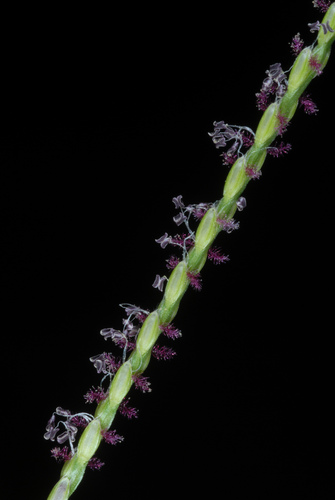
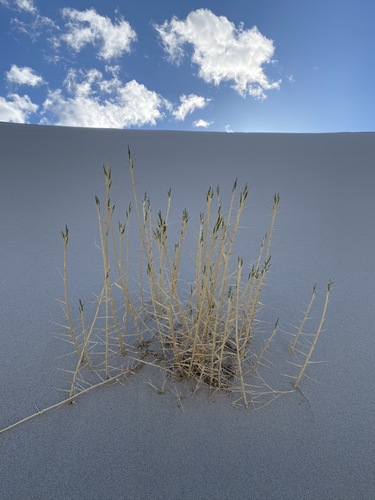
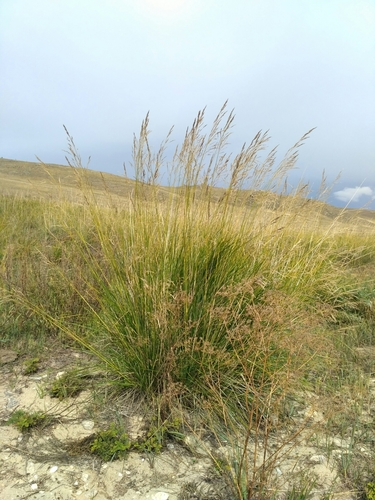
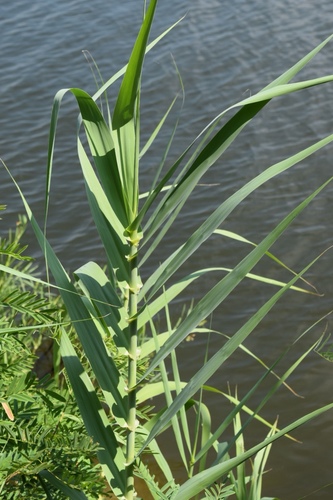
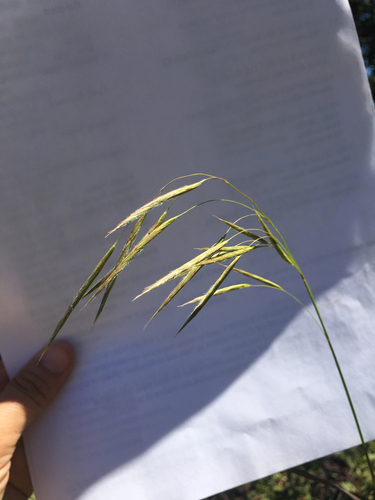
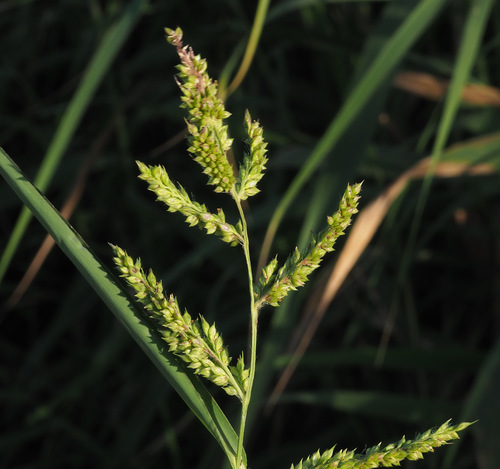
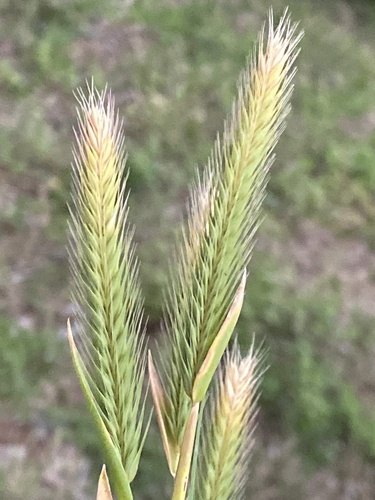
First formally described in 1818 by Thomas Nuttall, Hordeum pusillum Nutt., commonly called little barley, is an annual flowering plant. It is native to most of North America, primarily the United States and southwestern Canada. It belongs to the subfamily Pooideae of the grass family Poaceae. Mature plants reach an approximate height of 14 to 40 cm (5.5 to 15.7 in), and reproduce through self-fertilization. Both leaves and spikelets grow in an alternate arrangement. Its leaves are flat and pubescent, measuring 2.4 to 12.7 cm (0.94 to 5.00 in) long and 2.0 to 4.5 mm (0.079 to 0.177 in) wide. The leaf sheath, which wraps loosely around the plant's stem, may be either glabrous or pubescent. The plant's inflorescence grows 4 to 8 cm (1.6 to 3.1 in) in length. Among each group of three alternating floral spikelets, only one is fertile. This species grows through the winter, and produces mature grains by April. It has a fibrous root system. Mature spikelets display a tan to brown color, while the stem shifts from a bluish-green hue to brown as the plant matures. Its typical habitat includes sunny sites on dry gravelly soils, rock outcrops, roadsides, railroads, waste areas, grasslands, and marsh edges. Pollination occurs between winter and summer. The central spikelet of each trio is fertile, while the two lateral spikelets are male and infertile. The plant produces small edible grains. It was a component of the Eastern Agricultural Complex, a group of cultivated plants used by Native Americans in the Pre-Columbian era. Little barley may have been domesticated before agricultural systems centered on maize displaced it.