About Hordeum marinum Huds.
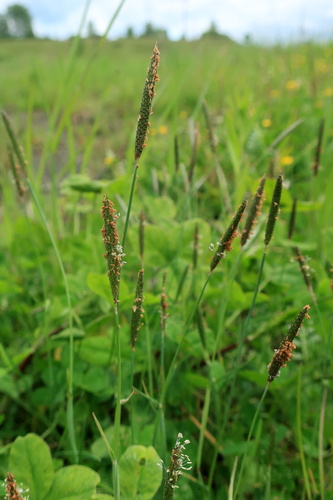
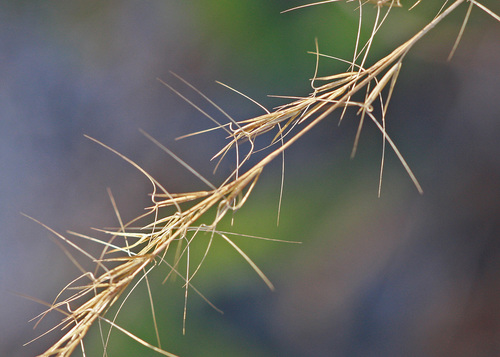
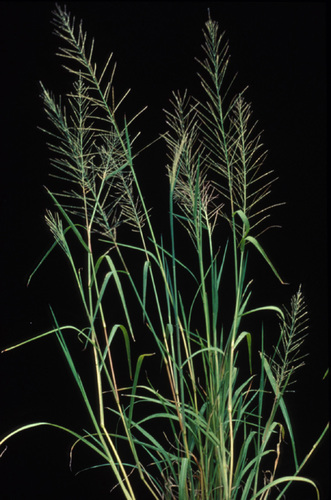
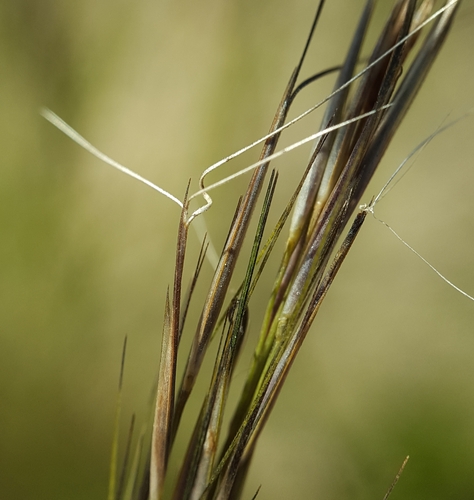
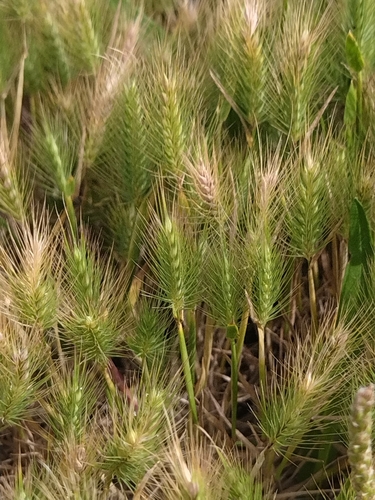
Sea barley (Hordeum marinum Huds.) is an annual grass with stems that range from spreading to erect, growing to approximately 40 cm tall. Compared to stem diameter, its leaf sheaths are somewhat inflated, and can be either glabrous (hairless) or minutely hairy. Each leaf has small rounded auricles and a short membranous ligule around 0.5 mm long. The leaf blade is also either glabrous or hairy, and reaches a maximum width of 4 mm. Its inflorescence is a false raceme that grows up to 5 cm long, is laterally compressed, and holds numerous clusters called triads, each made of three one-flowered spikelets. Within every triad, the central spikelet is sessile (stalkless) and fertile, while the two lateral spikelets grow on short pedicels and are barren. Each spikelet holds a single floret: the lemma is up to 8 mm long, with an awn projecting from its tip that reaches up to 22 mm long. A bristle-like glume up to 22 mm long sits on either side of each lemma. Sea barley is pollinated by either wind or self-pollination. When mature, its spikes become brittle and break into small fruit clusters, which are most often dispersed by winter floodwaters, or by the movement of livestock. Germination can occur in both autumn and spring. Sea barley frequently grows in the same areas as meadow barley or wall barley, and can be distinguished from both by key traits. Meadow barley is a perennial that often produces tillers, and does not have inflated leaf sheaths. Wall barley has three fertile flowers in each triad, and its awns are ciliate (hairy). Both meadow barley and wall barley consistently have hairy leaf sheaths, while sea barley often does not. Sea barley is native across Europe, North Africa, and extends eastward to central Asia. It has also become established as an introduced species in North America, South America, South Africa, Australia, and Japan. Though it is primarily a coastal plant, it is not restricted exclusively to seaside locations. Globally, its IUCN threat status is Least Concern, because it is widespread and has healthy, stable populations. In Britain, which lies at the northern edge of its native range, it is classified as vulnerable: while its range may have decreased in recent decades, the total extent of its populations, measured by the number of occupied grid squares, has actually increased. In France, its distribution and status follow the same pattern as in Britain: it is mostly restricted to coastal areas, with only casual non-established populations inland. Its national status in France is Least Concern, but in northern regions including Picardy and Pas-de-Calais, it has declined to Critically Endangered. Sea barley grows on patches of bare ground near the sea, most typically along paths or tracks, and sometimes in the upper sections of salt marshes. It is also a characteristic species of the Pannonian inland salt grasslands of south-eastern Europe, and very occasionally it occurs as a roadside halophyte growing many miles from the sea. It requires low competition from other plants, a condition usually created by fluctuating water levels or forms of disturbance such as livestock trampling and grazing. It flowers and fruits early in the growing season, typically in June in northern Europe, and reproduces entirely by seed. In Britain, it is a strictly lowland plant, and has not been recorded growing above 200 m above sea level. It has not been recorded as part of any defined native vegetation community in Britain, likely because it was too rare to be included in sampling. However, in Europe it is recognized as a characteristic species for several EUNIS habitat types: E6.13 Mediterranean continental halonitrophilic pioneer communities on inland mud flats; A2.523 Mediterranean short Juncus, Carex, Hordeum and Trifolium saltmeadows in brackish coastal lagoons; A2.552 Mediterranean coastal halo-nitrophilous pioneer communities on mud flats near the shore; and R6-1 Mediterranean inland salt steppe, which includes the Pannonian salt flats where evaporation creates saline soils. A number of fungi infect and attack sea barley. The smut fungus Ustilago bullata forms galls in the plant's flowers, while Tilletia controversa produces smut balls in the seeds. Several other fungal species cause damage to the leaves, including barley powdery mildew, Puccinia hordei (including P. hordei-murini and P. hordei-maritimi), and stem rust, which is known to infect the plant's culms. The aphid Metopolophium dirhodum has been recorded living on sea barley, and the thrips species Limothrips angulicornis feeds on its leaves.