About Horaga onyx (Moore, 1857)
Scientific name: Horaga onyx (Moore, 1857)
Male description: Upperside is cyaneous-blue. The forewing has a white patch outside the end of the cell, divided into 4 sections by veins 2, 3 and 4. The upper section is the smallest, and the spot below vein 4 is small. A black band runs along the costa: it is narrow at the base, increases in width outwards, occupies the entire apical space beyond the white patch, and extends broadly down the outer margin. The hindwing has a broadly blackish costal area, a narrow maculate black outer marginal band, a terminal black line, and an anteciliary bluish white thread. Tails are black and tipped with white. Cilia of both wings are black, and tipped with white on the hindwing and at the hinder angle of the forewing.
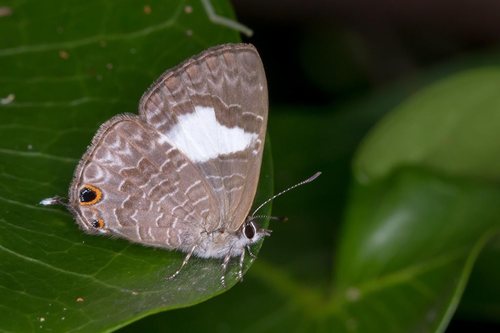
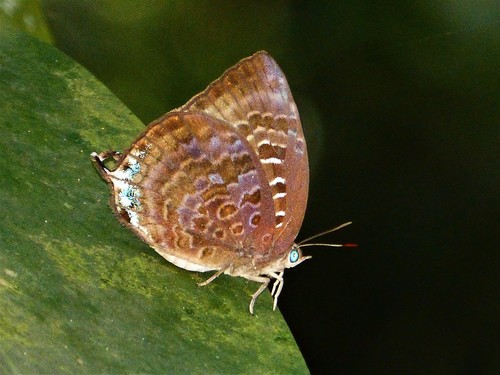
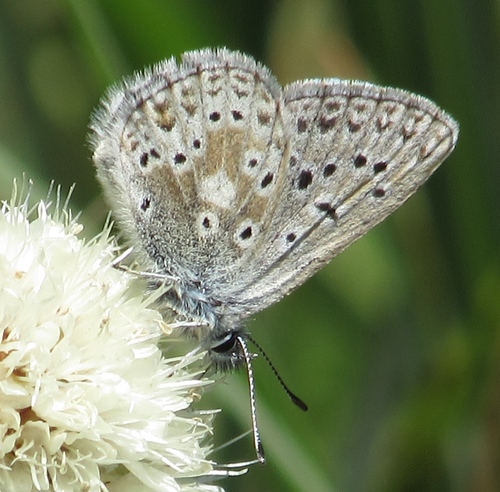
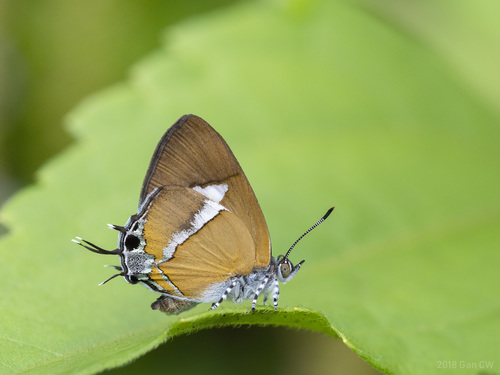
Underside is pale ferruginous-brown with a pinkish tint. The forewing has a white hinder marginal space below the sub-median vein. A broad white band with dark brown edges crosses the wing from the white hinder space to near the costa. Its inner edge passes just outside the end of the cell, is fairly erect and somewhat sinuous. Its outer margin is inwardly oblique from vein 4, narrowing the upper end of the band to a point below the costa. A dark brown terminal line is present. The hindwing has a narrower band in continuation of the forewing's band, edged inwardly with dark brown, somewhat diffuse on its outer side. The band is somewhat constricted in its middle, extending from the costa (where it is broadest) down to the first interspace, where it is angled and runs inwards as a straight black line that bears some metallic blue-green spots. Two similar spots sit below the angle, and three or four sit on the abdominal margin above the anal angle. There is a black anal spot, and a black spot in interspaces 1 and 2, each with a metallic blue-green spot attached to it. A dark brown marginal line is present, with a white thread inside it. Cilia of both wings are white and contain a medial brown line. Antennae are black and ringed with white. The head and body above and below match the wing color, and the abdomen is whitish beneath and at the sides.
Female description: Upperside is paler and duller blue. The discal white patch on the forewing is larger, more complete, and usually oval-shaped. Underside matches the male but is paler, and the white bands are broader.
This butterfly has a wingspan of 27 to 33 mm. For both sexes, the upperside is blue with broad black apex, termen and costa. The underside is dark yellowish or greenish brown, with an irregular and variable broad white discal band across the wings. On the underside of the male forewing, a well defined brand runs along the basal half of vein 1. The underside of the hindwing has a well defined white band.
Range: This butterfly is mostly found in India (from Western Ghats, Maharashtra southwards, and from Himachal Pradesh to Arunachal Pradesh), and also occurs in Nepal, Bhutan, Bangladesh, Myanmar and Sri Lanka. It is also found in Peninsular Malaya, Borneo, Singapore, Langkawi, Java, Sumatra, Bangka, Hong Kong and the Philippines.
Habit and habitat: It is found in thick hilly forests, and never occurs on plains. Its flight is weak, it prefers not to come out into the open, but does bask on leaves. In the north of its range, it can be found flying up to 2,000 m on hills, with flight periods from March to May and September to October.
Larval food plants: Coriaria nepalensis (Coriariaceae) and Mangifera indica.