About Hopia obtusa (Kunth) Zuloaga & Morrone
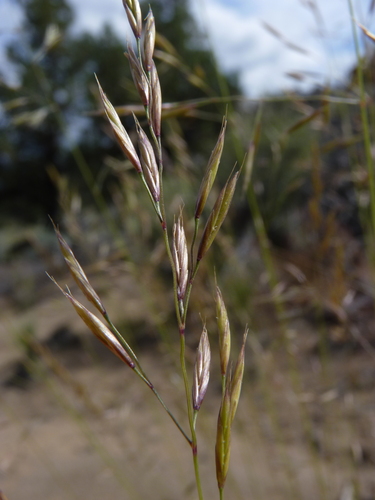
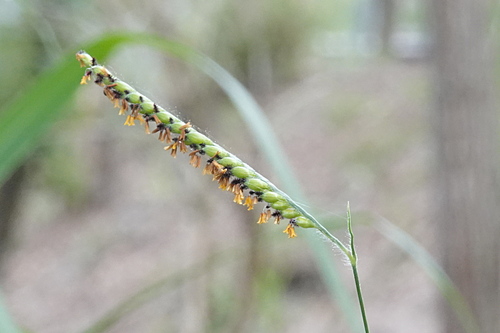
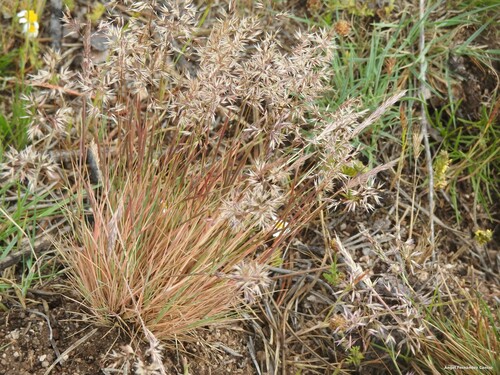
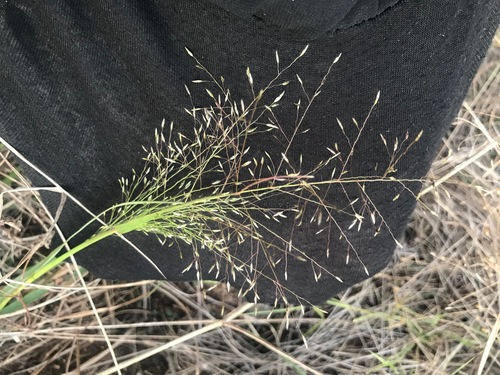
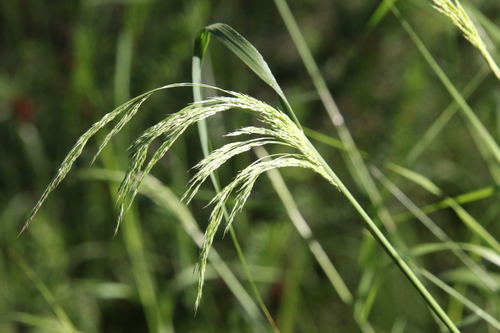
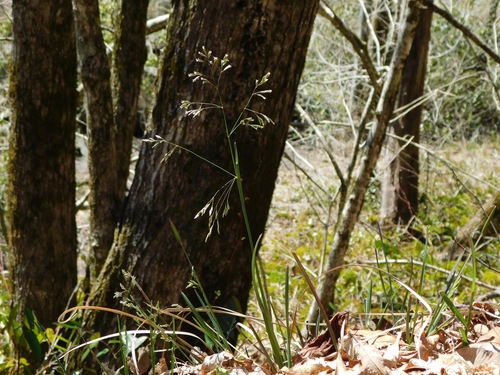
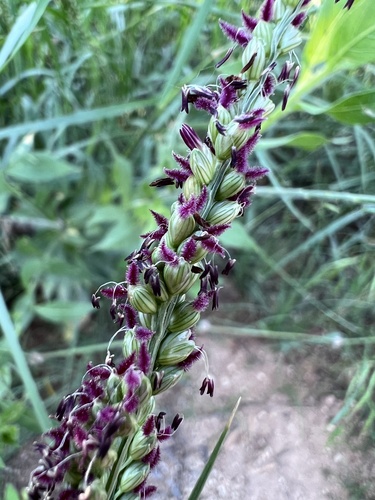
Hopia obtusa is a perennial grass species with stems reaching 20 to 80 centimetres (7.9 to 31.5 in) in height. It produces long, creeping stolons that have swollen, villous nodes, and may also develop short rhizomes. Its culms typically grow in small, compressed, glaucous clumps that are either erect or decumbent. Nodes on lower portions of the plant are hairy, while upper nodes are glabrous. Leaf sheaths are pubescent to pilose on the lower plant and glabrous higher up. This grass has membranous, truncate, irregularly denticulate ligules measuring 0.2–2 millimetres (0.0079–0.0787 in). Leaf blades are 3–26 cm (1.2–10.2 in) long and 2–7 mm (0.079–0.276 in) wide; they are ascending, firm, glaucous, sparsely pilose near the base, often scabrous along the margins, and involute toward their tips. The panicles of Hopia obtusa are 5–15 cm (2.0–5.9 in) long and 0.8–1.5 cm (0.31–0.59 in) wide, and hold 2 to 6 spikelike, erect, puberulent, 3-angled branches. Ultimate branchlets are arranged one-sided. Pedicels are paired and congested: some spikelets grow on short pedicels 0.1–1 mm (0.0039–0.0394 in) long, while others grow on longer pedicels 1.5–2.5 mm (0.059–0.098 in) long. Spikelets are 2.8–4.4 mm (0.11–0.17 in) long, ellipsoid, terete to slightly laterally compressed, glabrous, and obtuse. Lower glumes are approximately three-quarters the length of the entire spikelet and have 5 or 7 veins. Upper glumes and lower lemmas match the full length of the spikelet and have 5 to 9 veins. Lower florets are staminate, with their lower paleas measuring 2.5–3.5 mm (0.098–0.138 in) long. Upper florets are puberulent at their bases and apices. Flowering occurs from May through October. Hopia obtusa grows in seasonally wet sand or gravel, most commonly on stream banks, in ditches, along roadsides, and in wet pastures and rangeland. Its native range stretches from the southwestern United States to central Mexico. It acts as a larval host plant for the dotted roadside skipper.