About Hooveria purpurea (Brandegee) D.W.Taylor & D.J.Keil
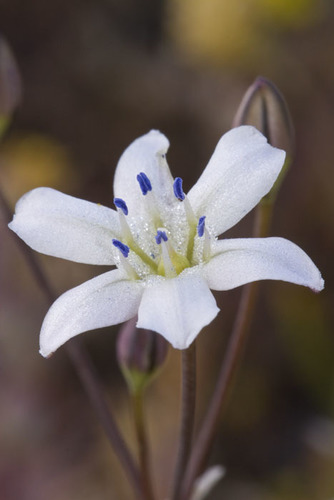
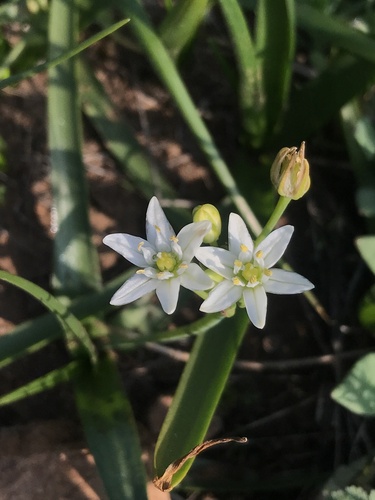
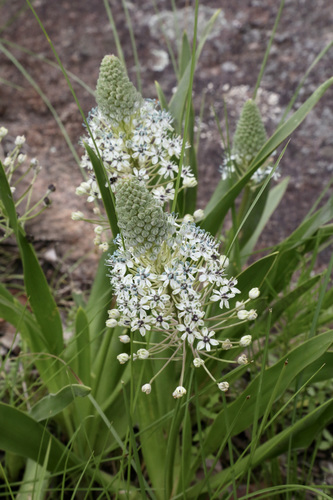
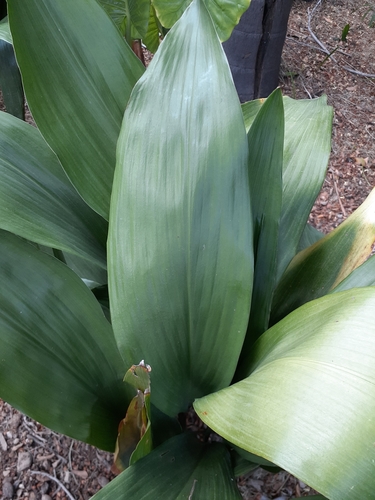
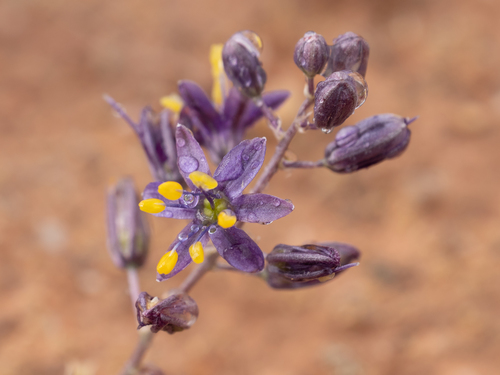
Hooveria purpurea is a perennial bulb plant. Its bulb is roughly 3 centimeters in diameter, and it produces narrow, wavy bright green leaves with thick midribs at the base of the stem. Most plants grow between one and eight leaves, though some individuals have been recorded with up to fourteen. The stem holds flowers at widely spaced nodes. Each flower has curled blue or purple tepals, each less than one centimeter long, plus long stamens with yellow anthers surrounding a protruding style. This species has two varieties that can be distinguished by their mature height: var. purpurea, commonly called purple amole, grows up to 40 centimeters tall, while var. reducta, commonly called Camatta Canyon amole, reaches only 20 centimeters. Approximately 90% of all individuals of the species belong to var. purpurea. Hooveria purpurea blooms from May to June. This species grows in Mediterranean climate regions with hot, rainless summers and wet winters. It inhabits woodland areas on the Southern Monterey and San Luis Obispo California coastline, growing on highly weathered, rocky, reddish clay soils in foothill woodland near south-central San Luis Obispo County. Hooveria purpurea var. reducta is endemic to the Santa Lucia Range of Monterey and San Luis Obispo Counties. It is found only at two sites: the Army installation Fort Hunter Liggett, and the National Guard post Camp Roberts, where there are four total populations holding probably fewer than 10,000 total individuals, in a habitat of grassland with patches of oak woodland. Camatta Canyon amole (var. reducta) is also recorded only from the La Panza Range in central San Luis Obispo County, around 61 kilometers away from the nearest purple amole population, with a single population that has a variable number of individuals. Population sizes are hard to estimate because these plants bloom infrequently and go dormant for multiple growing seasons at a time. Both varieties of Hooveria purpurea grow in soils covered by cryptogamic crusts. Purple amole is most often found on undisturbed or recovering soil crusts dominated by cyanobacteria, over clay soils topped with a loam and gravel layer. Much of purple amole's existing habitat is fragmented, due to a history of crop cultivation in the region. Plant associates that grow alongside purple amole include rusty popcornflower (Plagiobothrys nothofulvus), miniature lupine (Lupinus bicolor), California goldfields (Lasthenia californica), yellowflower tarweed (Holocarpha virgata), and wavyleaf soap plant (Chlorogalum pomeridianum), another soap plant species. Camatta Canyon amole grows in dry, pebbly, red clay soils. While some sources claim it is part of the serpentine soils flora, it most often grows on a unique form of laterite, and never grows on serpentine. Floral associates of Camatta Canyon amole include crown brodiaea (Brodiaea coronaria), bluedicks (Dipterostemon capitatus), winecup clarkia (Clarkia purpurea), and sometimes chamise (Adenostoma fasciculatum). There is a positive correlation between winter rainfall totals and the number of purple amole plants that bloom the following spring.