About Honckenya peploides (L.) Ehrh.
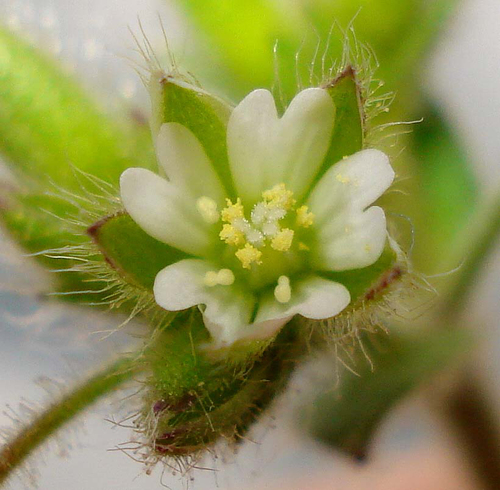
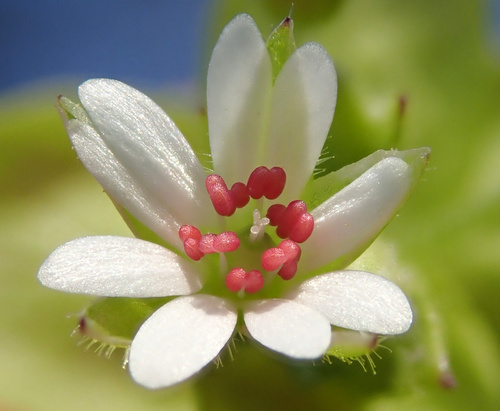
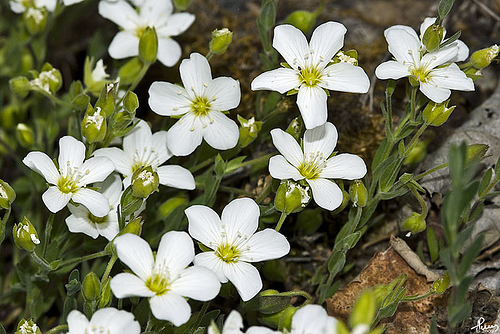
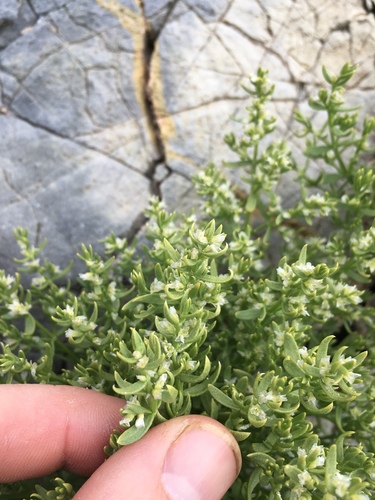
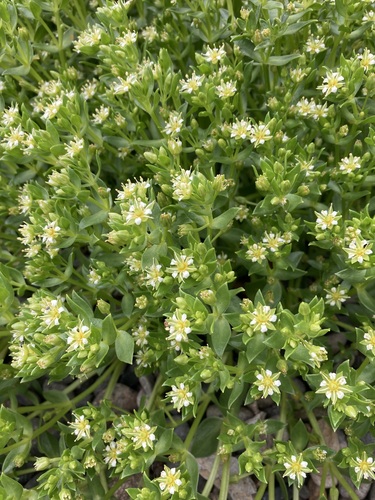
Honckenya peploides (L.) Ehrh. is a small, subdioecious spreading plant that forms patches on sand and shingle above the high water mark of beaches. Its branching stem grows buried in sand. Leaves grow in opposite pairs; they are fleshy with membranous margins, pale yellowish-green, and shaped ovate, oblong or lanceolate, usually with pointed tips. Flowers are often dioecious, with floral parts arranged in groups of five. They grow from upper leaf axils, and have ovate to lanceolate sepals, greenish-white petals of roughly the same length as the sepals, and three styles. The fruit is a capsule that is larger than the sepals and superficially resembles a pea. In pistillate (female) flowers, stamens do not develop fully; in staminate (male) flowers, capsules develop poorly. There are two recognized subspecies. The nominate subspecies H. p. peploides has ovate to lanceolate leaves, with flowers growing singly in upper leaf axils. H. p. major is a coarser plant with longer, more slender leaves, and its flowers are mostly borne in a multi-flowered cyme. Honckenya peploides has a circum-boreal distribution across both temperate and arctic regions. It grows in coastal areas on sand, shingle and pebbles, and is found in northern Europe (including Britain), northern Asia, and North America. Both the leaves and seeds of Honckenya peploides are used as food. Its shoots and leaves are rich in vitamin A and vitamin C, and can be eaten as a green leafy vegetable either raw or cooked. They can also be fermented to make a preserve similar to sauerkraut; in Iceland, they are fermented in whey to produce a drink. The seeds are small and time-consuming to collect. They can be ground and added to flour, or used as a garnish.