About Homodotis megaspilata (Walker, 1862)
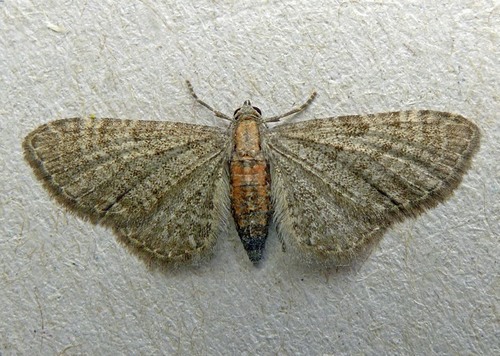
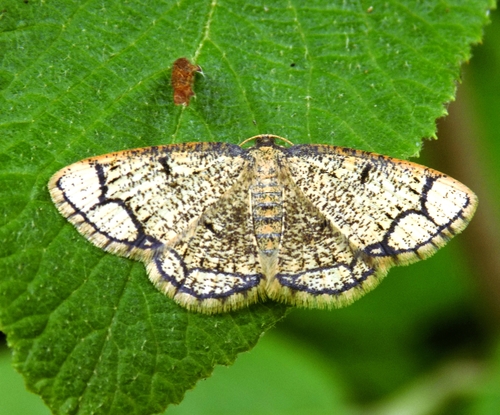
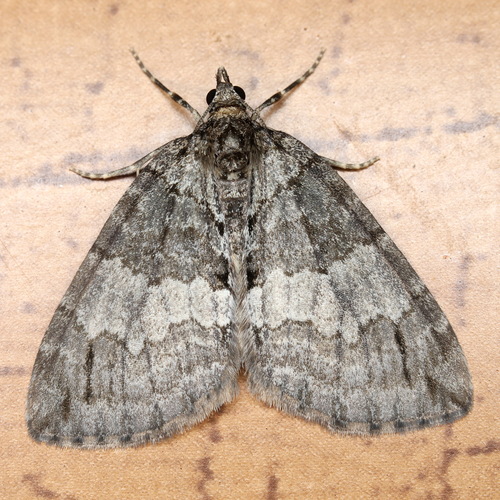
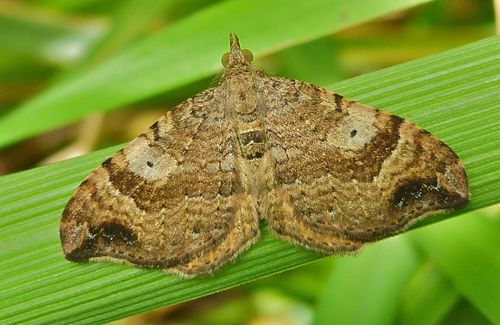
In 1898, Hudson described the adult individuals of Homodotis megaspilata as follows: The wingspan of adults is approximately 1 inch. Forewings are dull ochreous; a series of fine, wavy brown and reddish transverse lines near the base form a rather broad basal band. After this band is a pale central area that holds a blackish dot above its middle. Next comes a very distinct band composed of multiple fine wavy grey lines, which has a rounded projection near its middle. Following this band are numerous pale brown curved marks that form more or less broken transverse lines. There is always an oblique slaty patch below the forewing apex, and a series of minute dots along the termen. Hindwings are ochreous brown, slightly darker toward the base, and marked with numerous indistinct wavy brown lines. The forewing apex is very pointed and slightly hooked downward, and the termen is bowed near the middle. Females are much duller and more uniform in color than males, and have simple antennae. This species is extremely variable in appearance. Some male specimens have several more or less distinct white markings on the middle of the forewings, and the transverse bands also differ considerably in both size and intensity. Females are less variable, but in some specimens the forewing bands are almost absent, while other females have rich brown forewings with a very conspicuous dark central band. Adult H. megaspilata can be distinguished from other similar-looking species by the blunt hook-shaped tips of their forewings. This species could potentially be confused with Homodotis falcata, as their ranges overlap from Dunedin southward. However, H. falcata is a larger moth with forewings that are less strongly hooked. Homodotis megaspilata is endemic to New Zealand and is very common throughout the country. This species lives in native forest, scrub, coastal areas, and domestic gardens. Its larvae feed on dead leaves, and have been recorded feeding on leaf litter from Geniostoma ligustrifolium. Adult moths have been documented pollinating Olearia virgata and Leptospermum scoparium, and adults have also been observed visiting the flowers of Meticytus ramiflorus. When first laid, the eggs are pale yellow. They turn dark reddish-brown several days before the young larva hatches. The young larva is rather stout, dark brownish-black, marked with numerous fine parallel ochreous lines, and its whole body is covered with rather long bristles. It has been described as resembling "the fruiting body of a minute knobbed fungus". Larvae of this species are known to be preyed on by mice and by Cermatulus nasalis nasalis. H. megaspilata pupates on the ground inside a cocoon hidden in a dead leaf. This species probably hibernates in the adult (imago) stage during winter. Adults are active on the wing from October to April. They are nocturnal, flying in the evening starting at dusk, and are attracted to light.