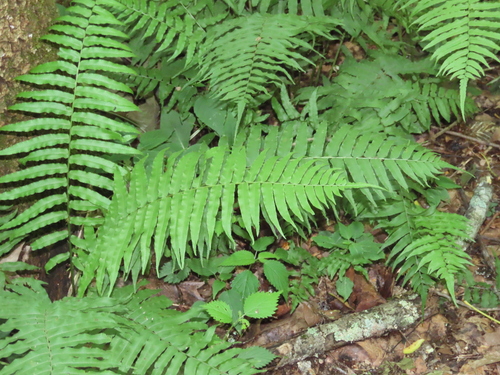
About Homalosorus pycnocarpos (Spreng.) Pic.Serm.
Scientific Name and Stem Growth
Homalosorus pycnocarpos (Spreng.) Pic.Serm. grows from creeping stems.
Frond Dimensions
Its clustered fronds reach approximately 90 cm (35 in) in length and 15–20 cm (6–8 in) in width.
Leaf Blade Structure
The leaf blade is oblong-lanceolate and once-pinnate. The pinnae are linear, either more or less entire or marked with shallow indentations.
Fertile vs Sterile Leaf Morphology
Fertile leaves resemble sterile leaves, but are narrower and have more widely spaced pinnae.
Sori Characteristics
The sori are long, straight or slightly curved, and grow in two lines along the underside of leaf pinnae.
Indusia Traits
The indusia are thick and prominent.
Etymology of Specific Epithet
The arrangement of the sori gives this species its specific epithet pycnocarpos, which means 'crowded fruits'.
Endemic Range
Homalosorus pycnocarpos is endemic to eastern North America. It is widespread across the region, ranging from southern Ontario to the Gulf of Mexico, and westward to Minnesota and Arkansas.
Habitat and Elevation
It grows in moist (mesophytic) woods and ravines, in neutral or basic soils, at elevations between 150–1,000 m (500–3,300 ft).


