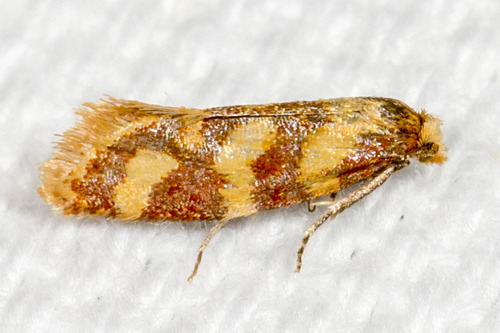
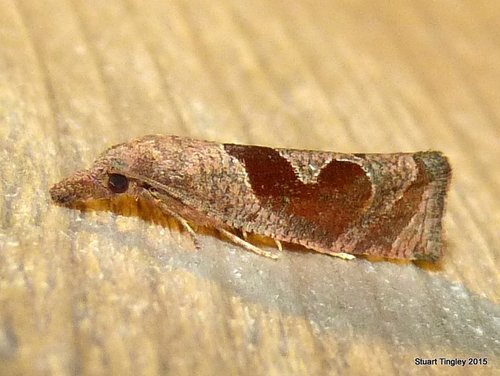
About Holocola zopherana (Meyrick, 1881)
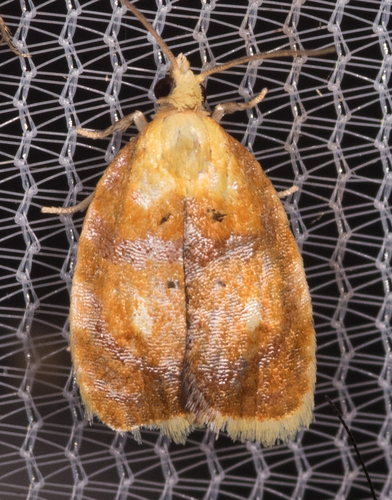
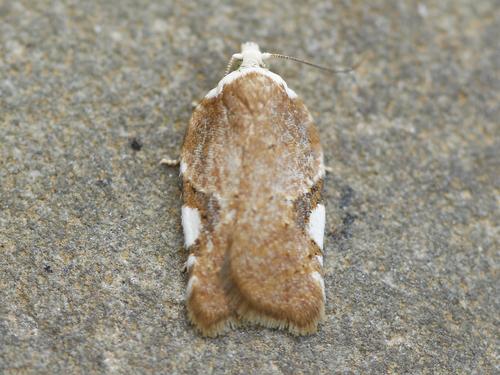
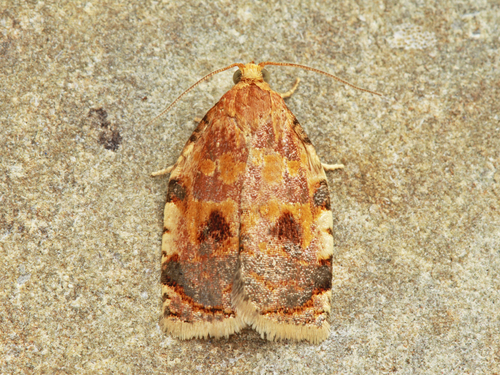
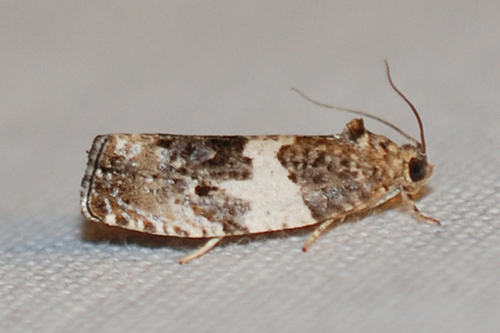
This species has the scientific name Holocola zopherana (Meyrick, 1881). Hudson described the species' larva and pupa as follows: The larva, which feeds on manuka (Leptospermum), is slightly over 1/4 inch (8 mm) in length. It is cylindrical and stout, tapering rapidly towards the posterior end; its head and the plate of the second segment are bright shining ochreous; the rest of its body is ochreous, with three rows of rather irregular crimson spots on the dorsal area. Larvae are found in early December. The pupa is enclosed in a rather thin silken cocoon, and the insect passes the winter in the pupal stage. Meyrick originally described the adults of this species as follows: Both males and females have a wingspan of 5 to 6 lines (roughly 10–13 mm). The head, palpi, and thorax are grey, more or less speckled with white; the head is sometimes almost completely white; the palpi are not tufted. The antennae are dark fuscous; in males, they are somewhat thickened and notched about one-eighth of the way from the basal joint. The abdomen is dark grey, with silvery-whitish segmental margins. The legs are whitish, with the anterior and middle tibiae and all tarsi sharply banded with dark fuscous. The forewings are very narrow, the costa is slightly arched, the apex is produced, the hindmargin is sinuate and very oblique; they are dark grey, speckled with whitish. The costa has very oblique fine parallel stripes of blackish-grey. A rather broad, ill-defined white streak runs beneath the costa from the base to the apex, crossed by an oblique dark grey fascia-like streak before the middle, and three or four slender very oblique dark grey stripes between that streak and the apex. The middle of the disc is somewhat suffused with blackish; there is an ill-defined black spot in the disc above the anal angle. There is generally a row of about three ill-defined black spots above the anal angle towards the hindmargin, preceded and followed by an obscure silvery-metallic line. The forewing cilia are dark grey, paler towards the anal angle, with a blackish apical spot; the costal cilia are white. The hindwings are thinly scaled, grey, and darker at the extremity; the cilia are pale grey, with an indistinct darker line near the base; veins 3 and 4 are coincident. This species can be distinguished from similar-looking species by its white subcostal streak running from base to apex, though the colouration of adult moths is variable. Hudson noted that this species varies both in the depth of its greyish-brown colouring, the width of the white streak, and the extent and intensity of its other markings. In terms of distribution, this species is found in both Australia and New Zealand. In New Zealand, it can be found throughout the country anywhere its host species, mānuka, grows.