About Holcus lanatus L.
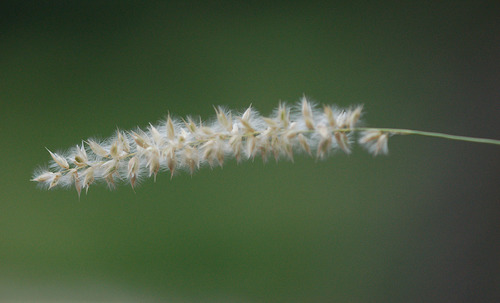
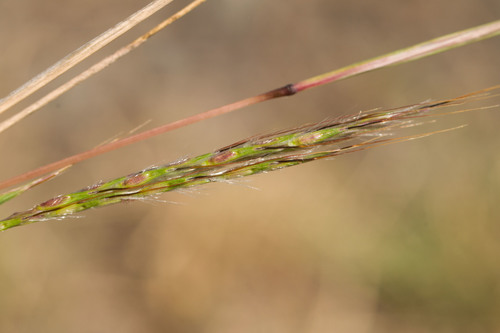
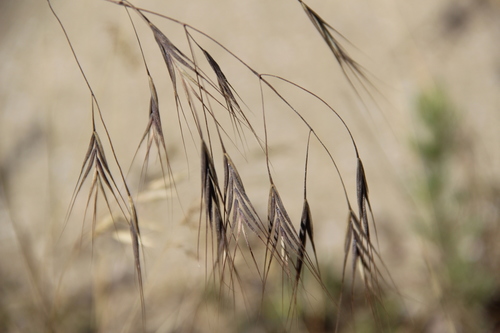
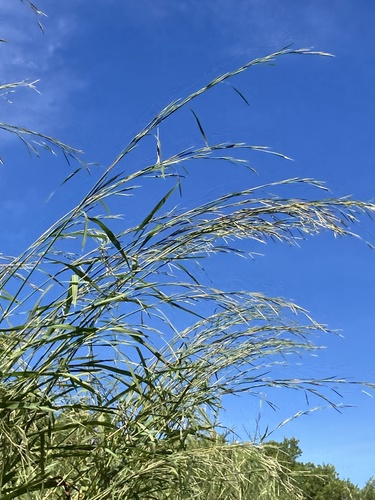
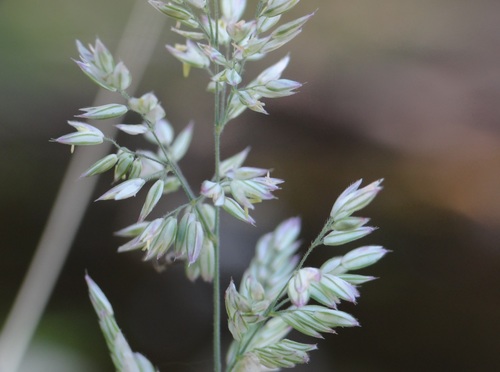
Holcus lanatus L. has velvety grey-green leaves and round stems. The base of each stem is white with pink stripes or veins, a trait commonly nicknamed "stripy pyjamas". Its inflorescence is robust and often tinged purple. The species produces large quantities of seed, and rapidly colonizes disturbed ground. It prefers wetter growing conditions, and is commonly found growing alongside drainage ditches. Its ligule is 1–4 millimetres long, with a blunt shape and a hairy texture. This species can be told apart from Holcus mollis by its beardless culm nodes, lack of rhizomes, and awn that becomes hooked when dry and does not extend past the tips of the glumes. Holcus lanatus is known to hybridize with H. mollis, producing a male sterile hybrid with a 2n = 21 chromosome count. Hybrids generally share the morphology of H. lanatus. Holcus lanatus spreads vegetatively by growing new shoots and roots at its nodes. Plants form a dense blanket of runners across the soil surface. Semi-prostrate clusters of shoots called 'mops' may develop at the end of runners, and these mops root easily when they come into contact with moist soil. In a 1970 European survey of weed contamination in cereal seed, Holcus lanatus seed was detected in 1% of tested samples. H. lanatus indicates growing conditions of poor soil, low grazing intensity, and poor drainage. It tolerates a wide range of soil pH, but grows best at pH between 5.0 and 7.5. It tolerates a broad range of climatic conditions across a wide altitude range, but severe frosts can kill the plant. It cannot survive repeated trampling or constant puddling. In some European locations, it can be controlled by increasing available potassium and phosphorus, increasing livestock grazing, and improving drainage. These control methods are not as effective in North America. In its natural habitat, Holcus lanatus serves as a food source for butterflies including the speckled wood, the wall, and especially the small skipper. It is rarely used as food by the Essex skipper. Within its native range, it can grow in plant associations such as the Juncus subnodulosus–Cirsium palustre fen-meadow habitat.