About Histrionicus histrionicus (Linnaeus, 1758)
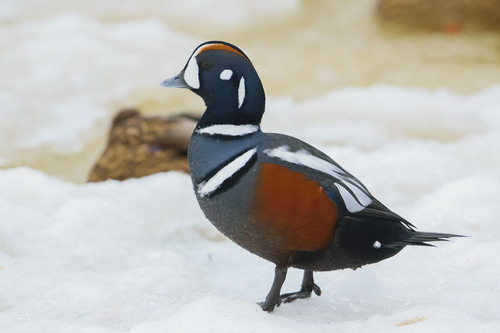
Adult breeding males of Histrionicus histrionicus have a colorful, complex plumage pattern. Their head and neck are dark slate blue, with a large white crescent marking in front of the eye that extends up to the crest, a small round dot behind the eye, and a larger oval spot along the side of the neck. A black crown stripe runs across the top of the head, with chestnut patches on either side. A white collar with a black border separates the head from the breast. Most of the body is a lighter slate blue, with chestnut sides. A black-bordered white white bar divides the breast vertically from the sides. The tail is black, long, and pointed. The speculum is metallic blue. The inner secondary feathers are white, and form white markings across the back when folded. The bill is blue-grey, and the eye is reddish. Adult females are less colorful, with brownish-grey plumage and three white patches on the head: a round spot behind the eye, a larger patch extending from the eye to the bill, and a small spot above the eye.
The species' breeding habitat is cold, fast-moving streams in northwestern and northeastern North America, Greenland, Iceland, and eastern Russia. Nests are usually placed in well-concealed locations on the ground near a stream. These birds are most often found near pounding surf and white water. They are short-distance migrants, and most winter near rocky shorelines on the Atlantic and Pacific coasts. They are very rare migrants to western Europe. The eastern North American population of this species is declining, and is classified as endangered. Possible causes for this decline include habitat loss from hydroelectric projects, and mortality from oil spills near coastal areas.