About Hiptage benghalensis (L.) Kurz
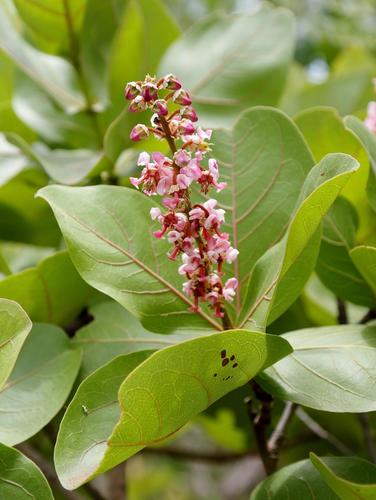
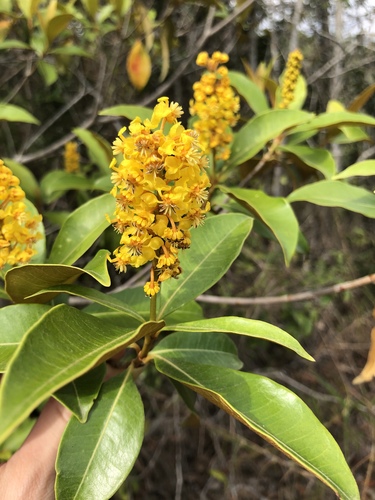
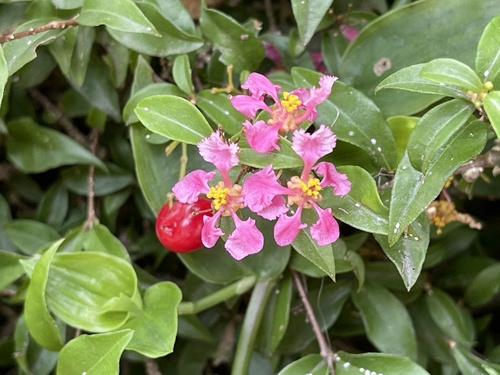
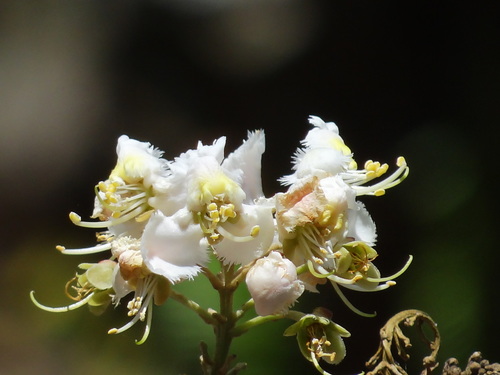
Hiptage benghalensis (L.) Kurz is a stout, high-climbing liana or large shrub. Its stem is covered in white or yellowish hairs. Leaves grow from lanceolate to ovate-lanceolate in shape, reaching approximately 20 cm (8 in) long and 9 cm (4 in) broad, with petioles up to 1 cm long. Its scandent branches can grow up to 5 m (16 ft) high. This species flowers intermittently throughout the year, producing fragrant blooms that grow in compact axillary racemes holding 10 to 30 flowers each. Flowers range in color from pink to white, and have yellow markings. Its fruits are samaras that bear three spreading, papery wings shaped from oblanceolate to elliptic, each 2–5 cm long. Hiptage benghalensis propagates via wind dispersal or from cuttings. Hiptage benghalensis is native to India, Southeast Asia, and the Philippines. It has been recorded as a weed in Australian rain forests, and is known to be invasive in Mauritius, Réunion, Florida, and Hawaii. In these invasive regions, it thrives in dry lowland forests, where it forms impenetrable thickets and smothers native vegetation. In 2001, the Florida Exotic Pest Plant Council (FLEPPC) listed Hiptage benghalensis as a Category II plant, a classification for species that have demonstrated potential to disrupt native plant communities. Hiptage benghalensis is widely cultivated across the tropics for its attractive, fragrant flowers. It can be trimmed to form a small tree or shrub, or trained to grow as a vine. It is also occasionally cultivated for medicinal use in the alternative medicine practice of Ayurveda. In this system, its leaves and bark are described as hot, acrid, and bitter, and are noted to have insecticidal and vulnerary properties. They are considered useful for treating biliousness, cough, burning sensation, thirst, and inflammation, and are also said to treat skin diseases and leprosy.