About Hippuris vulgaris L.
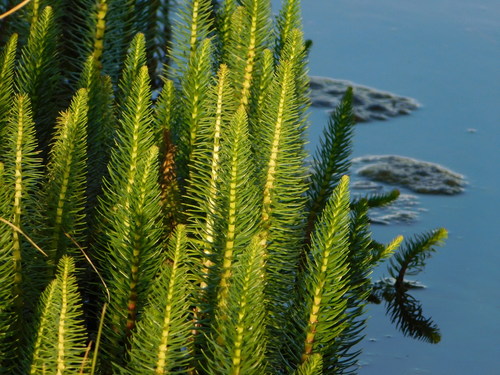
Common mare's tail, scientifically named Hippuris vulgaris L., is a creeping perennial herb that grows in shallow waters and mud flats. It roots underwater, but most of its leaves are located above the water surface. Its leaves grow in whorls of 6 to 12. Above-water leaves are 0.5 to 2.5 cm long and up to 3 mm wide, while underwater leaves are thinner, limper, and longer than above-water leaves — this size difference is especially notable in deeper streams. Stems are solid, unbranched, and often curved, and can reach up to 60 cm in total length. In shallow water, stems extend 20 to 30 cm out above the water surface. This species grows from stout rhizomes. Its flowers are inconspicuous, and not all individual plants produce flowers. Studies of Hippuris vulgaris on the Tibetan Plateau have found that it is a prolific methane emitter. The roots of Hippuris vulgaris extend into the anoxic zone of wetland soils and create a pathway that allows methane produced in the anoxic zone to travel to the atmosphere. It can act as a troublesome weed by blocking water flow in rivers and ditches.