About Hippocrepis comosa L.
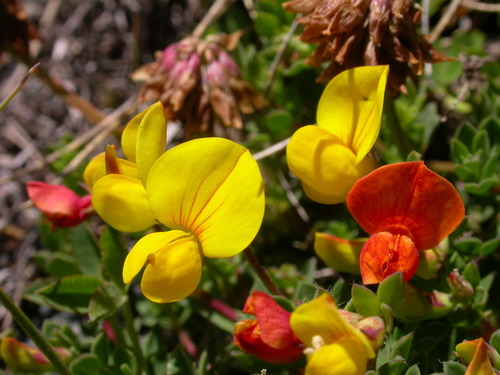
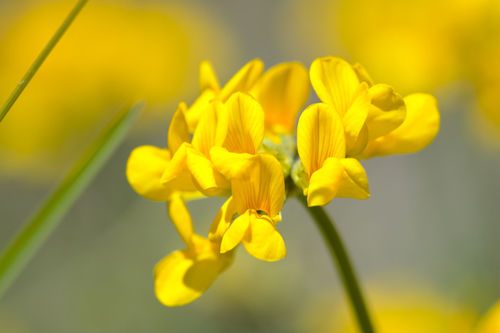
The general appearance of Hippocrepis comosa L. varies based on its habitat: it may grow as upright clumps of flowers, spread prostrate leafy runners across a wide area, or occur as single scattered flowers. Its flowers are small, typically yellow, and sometimes orange or red when young, turning yellow as they mature. The flowers have the characteristic shape of plants in the Fabaceae family, and bloom for roughly two weeks around May. Hippocrepis comosa is found in the United Kingdom, with most populations concentrated in the south of the country. It is a calciole, meaning it grows only on chalk and limestone. It is a hardy species that tolerates long cold winters and dry summers consistently year after year. Established colonies are not damaged by sheep grazing, and are resistant to moderate trampling. They do not survive well after heavy ploughing or other ground disturbance, and will disappear from areas grazed by cattle, sometimes over the course of several years depending on grazing intensity. Hippocrepis comosa is the only food plant for caterpillars of two butterfly species: the chalkhill blue (Polyommatus coridon) and the Adonis blue (Polyommatus bellargus). Populations of this plant that support these butterfly colonies grow on longstanding ungrazed meadows, quarries, path edges, and wasteland. Outside of southern England and the Midlands, such as in the Gower and Yorkshire populations, the local climate is not suitable for these two butterfly species. The most successful method to re-establish a Hippocrepis comosa colony is planting individual grown plants, as direct sowing has very low success rates. Even when planting individual plants, there is no guarantee the colony will persist over 20 years. It is even less likely that new Hippocrepis comosa plantings will be colonized by significant chalkhill blue butterfly populations within 50 years of establishment.