About Hippocamelus antisensis (d'Orbigny, 1834)
Scientific Name and Build
The taruca, scientifically named Hippocamelus antisensis (d'Orbigny, 1834), is a medium-sized deer with a heavy build.
Body Measurements
It measures 128 to 146 cm (50 to 57 in) from head to rump, has an 11 to 13 cm (4.3 to 5.1 in) tail, and stands 69 to 80 cm (27 to 31 in) tall at the shoulder.
Weight and Sexual Dimorphism
Adult tarucas weigh between 69 and 80 kg (152 and 176 lb), and like most deer species, males are noticeably larger than females.
Body Fur Coloration
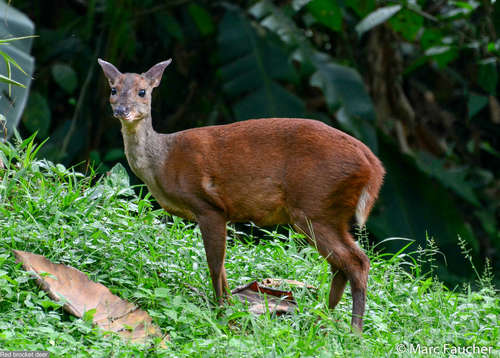
Most of its body is covered in sandy brown fur, with white patches on the underside of the head, neck, tail, and genital region, as well as on the inner surface of the forelegs.
Female Facial Markings
Females often have a dark brown patch on the forehead, while facial markings are much more distinct in males.
Male Facial Markings
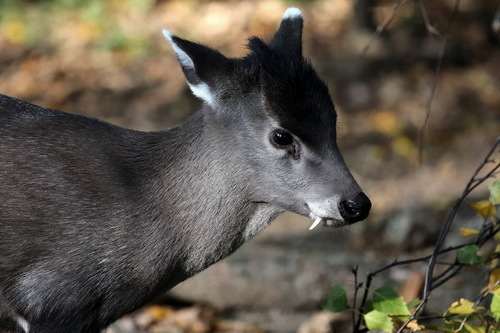
Exact patterns vary between individual males, but they generally have a black mask behind the nose, and a black Y- or V-shaped pattern across the forehead and snout.
Antler Presence
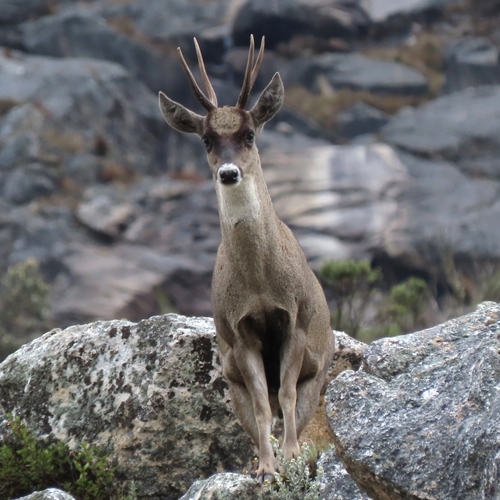
Like other deer, only male tarucas typically grow antlers.
Antler Size
The longer tine of a fully grown male usually measures around 30 cm (12 inches).
Antler Structure
Unlike most other South American deer — the only exception being the closely related huemul — taruca antlers have just two tines that branch from the base, with the posterior tine being the larger one.
Canine Teeth Dimorphism
Males also have canine teeth in their upper jaw; females usually, but not always, lack these teeth.
Geographic Range
Tarucas are found only in the Andes mountains, ranging from central Peru through Bolivia and extreme northeastern Chile into northern Argentina.
Previous Range Dispute
Earlier claims that tarucas also live in Ecuador are not supported by any evidence.
Population Estimate
Peru hosts the largest taruca population in South America; in 2008, researchers estimated that between 9,000 and 12,000 tarucas lived across the central Andes.
Northern Range Limit
The Huancabamba depression forms the northern limit of the species' range.
Altitudinal Range
Tarucas generally live at altitudes between 3,500 m (11,500 ft) and 5,000 m (16,000 ft).
Co-occurring Species
At lower altitudes within this range, they may share territory with the Peruvian whitetail deer, which is also endemic to the region.
Argentine Habitat
In Argentina, tarucas are found at 2,000 m (6,600 ft) to 3,000 m (9,800 ft), where they occupy grasslands with occasional shrubs and rocky outcrops, and typically stay near water.
Taxonomy
No subspecies of taruca are currently recognized.
Breeding Rut Period
The taruca's breeding rut lasts from May to July.
Rut Group Structure
During this period, deer split into smaller groups each containing a single adult male.
Antler Shedding
Males shed their antlers right after the breeding season ends in September.
Antler Growth Cycle
New antlers begin growing in December, and lose their velvet covering by February.
Gestation and Birth Period
Pregnancy lasts 240 days, so a single fawn is born between January and March, which coincides with the local rainy season.
Twin Occurrence
Twins have been recorded in captivity, but are very rare.
Post-Birth Behavior
The mother leaves her group to give birth, and keeps the fawn hidden behind rocky outcrops for the first month of its life.