About Hippasa holmerae Thorell, 1895
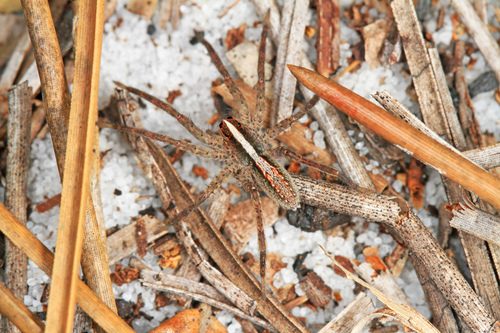
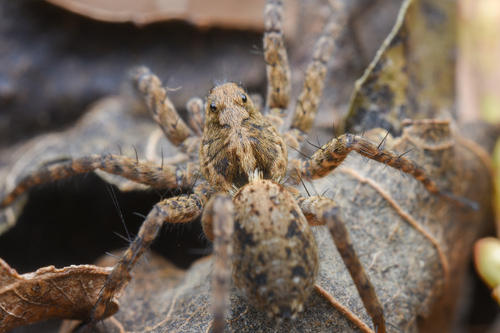
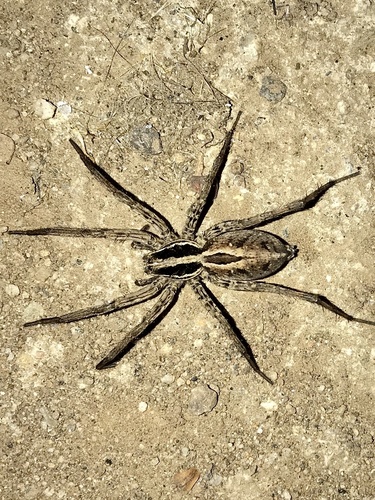
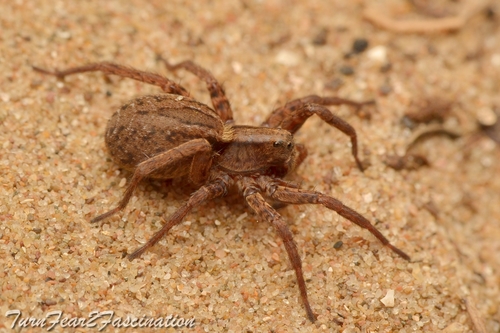
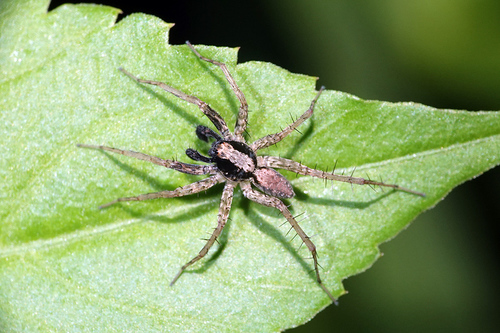
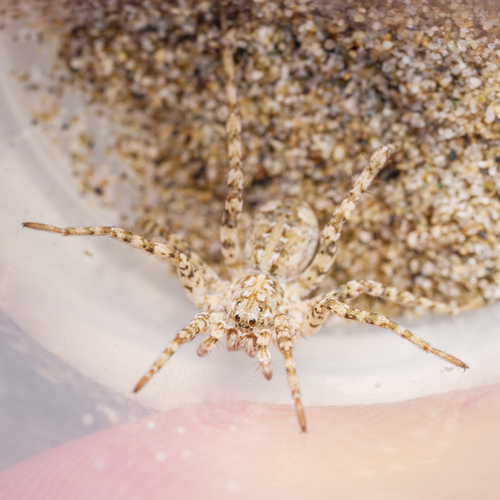
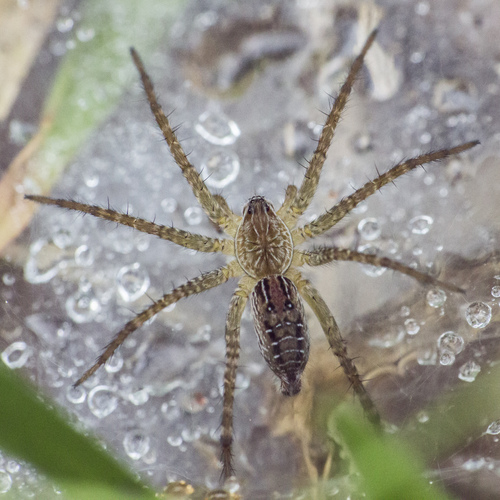
Hippasa holmerae Thorell, 1895 displays the standard wolf spider body plan, with a robust cephalothorax and abdomen. The cephalothorax is pale brown, marked with distinct white markings that form an elongated X-shape. This X-pattern is made up of two pairs of diverging white lines located in the cephalic and thoracic regions. The sternum is brownish, with a longitudinal black band running along its length. The abdomen has a blackish base color, marked with a series of clearer brown transverse spots, and is mottled with brown, black, and white pubescence. White pubescence forms two parallel lines at the base of the abdomen, plus a series of transverse lines that are often interrupted in the middle. Adult females of this species have a total body length ranging from 6 to 8 millimeters, while adult males are typically slightly smaller, averaging around 7.25 millimeters in body length. The legs are relatively long; in females, the fourth pair of legs is nearly five times the length of the cephalothorax. Hippasa holmerae has been recorded in India, Bangladesh, Myanmar, China, Taiwan, Laos, Singapore, and the Philippines. This species shows notable geographic variation across its range. A subspecies, H. h. sundaica, was originally described from Singapore by Thorell in 1895, but this taxon is now considered a synonym of the main species. In India, the species has been documented in multiple states, including Manipur, Uttarakhand, and West Bengal. It occurs in agricultural regions throughout its range, where it acts as an ecologically important predator of pest insects. Unlike most wolf spiders, which are wandering hunters, all Hippasa species construct funnel-shaped webs that are similar to the webs built by true funnel-web spiders. This web-building behavior is uncommon within the wolf spider family Lycosidae, and counts as an interesting example of convergent evolution. Hippasa holmerae lives in a wide range of environments, including grasslands, agricultural areas, and suburban gardens. It has specifically been observed in rice fields, where it acts as a beneficial predator of leafhoppers and planthoppers, insect pests that damage rice crops. These spiders are most often found at ground level, and may build their webs among vegetation or in sheltered locations.