About Hipparchia semele Linnaeus, 1758
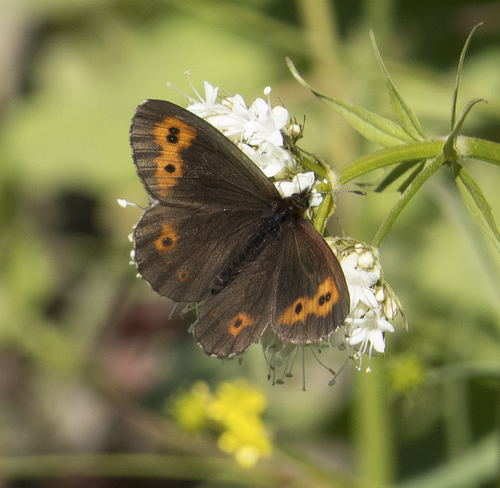
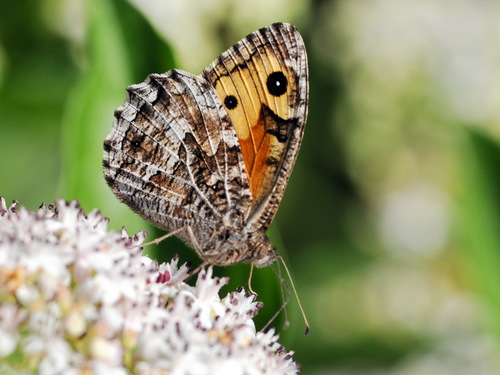
This species is Hipparchia semele Linnaeus, 1758. The description provided follows that in Seitz. The upperside of the female is similar to the preceding species: dark brown with a yellow-orange submarginal band that is more prominent in females and more faint in males. It has an interrupted fringe, two black blind or very faintly pupiled ocelli on the forewing, and a very small ocellus on the hindwing. The underside of the forewing is yellow-orange, surrounded by a marbled brown and white band that includes the two black ocelli, while the underside of the hindwing is marbled with brown and white. In H. semele, the upper bands are ivory-yellow and often obscured, especially on the hindwing. The male's upperside is almost entirely dark; the band is only noticeable on the hindwing as a row of faint ochre-yellow spots. Both sexes have a dark ocellus before the anal angle, set on a pale ochre ground; this ocellus is occasionally pupiled with white. The underside of the hindwing is darkly marbled, and a pale dust-like band forms the distal end of its basal portion. This band extends outward in a prominent tooth below the cell toward the margin. Hipparchia semele occurs at elevations between sea level and approximately 2,000 metres (6,600 ft). It is a European endemic species, found across almost all of Europe and parts of western Russia. In parts of northern and western Europe, including Scandinavia, Britain, Ireland, and the Baltic states, it occurs mostly in coastal areas. Its populations are declining in many areas, particularly inland. It is not present in western France, large parts of Greece, Albania, North Macedonia, areas south of Bulgaria, or on Mediterranean islands. H. semele populations typically live in dry, warm habitats that support their thermoregulatory behavior. In coastal regions, they are often found in sand dunes, salt marshes, undercliffs, and clifftops. In inland regions, they occupy heathlands, limestone pavements, scree, and brownfield land, and they are also known to live in old quarries, railway lines, and industrial areas. Colonies usually develop in areas with little vegetation and bare open ground, with patches of shelter and sun to help them regulate their body temperature. Much of H. semele's common habitat, such as heathlands, has been converted to agricultural land. Existing dry habitats are being overgrown by trees and other vegetation, which reduces the amount of optimal habitat available for graylings. All life cycle information provided here applies to populations in Great Britain, and some details may not match populations in other parts of the species' range. H. semele produces one generation per year. Eggs are laid singly from July to September, most often on the food plant. Newly laid eggs are white, and turn pale yellow as they develop. The egg stage typically lasts between two and three weeks. After hatching, caterpillars grow slowly, feed at night, and usually hibernate during cold weather in a deep patch of grass. The larvae are small and cream-colored, and go through four moults. First- and second-instar larvae feed from mid to late summer, then hibernate while still small as third instars at the base of a grass tussock. Feeding resumes in spring, and last-instar larvae are nocturnal, hiding at the base of grass tussocks during the day. The full sequence of larval instars occurs from August to June. By June, larvae are fully grown, and at this stage caterpillars spend most of their time basking in the sun on bare ground or rocks. Larvae are attracted to muddy puddles and sap from tree trunks. When ready to pupate, the caterpillar spins a cocoon in the ground. Pupation takes place in a silk-lined cavity below the ground surface. The pupa lies unattached in an earthen cell. The pupal stage lasts around four weeks. Pupae form from June to August, and adult butterflies emerge in August.