About Hipparchia neomiris Godart, 1822
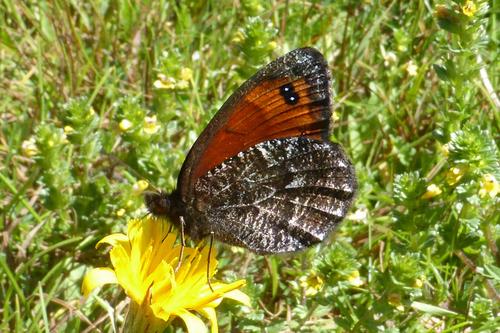
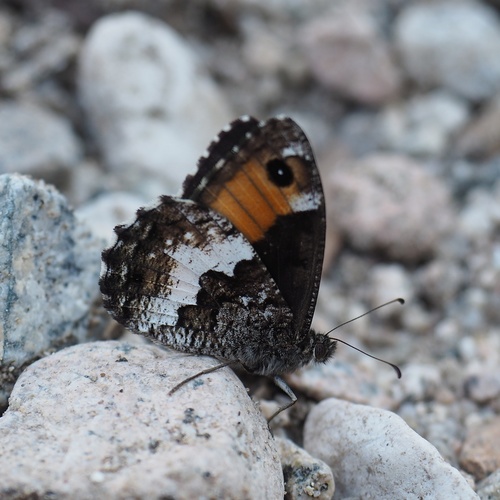
Hipparchia neomiris Godart, 1822 (previously referred to as S. neomiris God., with synonyms marmorae Hbn. and jolans Bon.) is similar to and closely related to Hipparchia alcyone. Its distal band is light orange, bright on the upper wing surface, very broad on the hindwing, sharply defined proximally, and tinged with reddish yellow distally. On the underside, the orange band of the forewing contrasts sharply with the black-brown basal area. The underside of the hindwing has a broad white median band that is bordered with black along its proximal edge. The apical ocellus of the forewing is centered with white on both the upper and lower wing surfaces. This species is found on Sardinia, Corsica, and Elba. The egg is almost globular, ivory-white, and minutely ribbed, and larvae hatch 14 days after the egg is laid. The larva is ivory-yellow, with a thin, black, dorsal double line; above the spiracles there is a black side-line that is interrupted on each segment. The larva has a pale brown head with black mandibles, and feeds on grass (as documented by Kollmorgen). Adult butterflies are found in mountainous areas at elevations of 700 m and above, from June through August. They are locally abundant, and often settle on the trunks of conifer trees.