About Hipparchia fatua Freyer, 1843
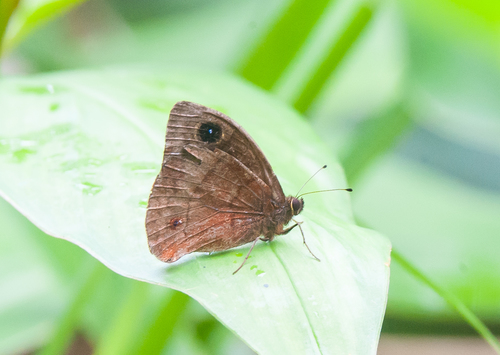
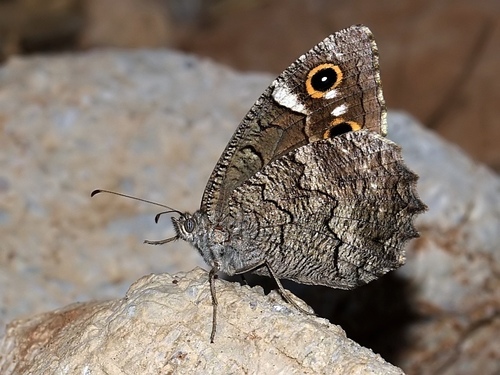
This species, Hipparchia fatua Freyer, 1843, was originally described as Seitz S. fatua Frr. (= allionii Hbn). It is very similar to the closely related preceding species Hipparchia statilinus, and is mostly larger in size. On the upper side of its wings, it differs by having a dark submarginal line; on the underside, the hindwing is more uniformly colored and mostly bears 2 deeply dentate black curved lines across the central area. The distal area of the upper hindwing is often very pale. The nominal species is found in Greece and Asia Minor. sichaea Led. (44c) is a very large form from Syria, with the underside of the hindwing prominently marbled. wyssi Christ. (44c), from the Canaries, is now classified as a full species; it is intermediate between sichaea and the nominal form, with some specimens matching nymotypical fatua and others closer to sichaea. sylvicola Aust. (44c), now reclassified as H. statilinus sylvicola (Austaut, 1880), resembles nymotypical fatua on the upper wing surface, but the underside of its hindwing is entirely uniformly brown-grey and completely lacks markings. It occurs in western Algeria, where it was collected at the same location as hansii, but flies in September while hansii is caught in July. The taxonomic status of these North African forms has not yet been fully resolved. Like related H. statilinus forms, H. fatua prefers sandy soil and pine forests. On the Canary Islands, the butterflies have been observed flying around coastal rocks, and preferentially settle on the sun-facing side of Pinus canariensis trunks. According to Staudinger, H. fatua specimens sometimes fly at night, entering lit windows and coming to lanterns. Adult butterflies fly from June to October. The larvae feed on various types of grass.