About Himantoglossum hircinum (L.) Spreng.
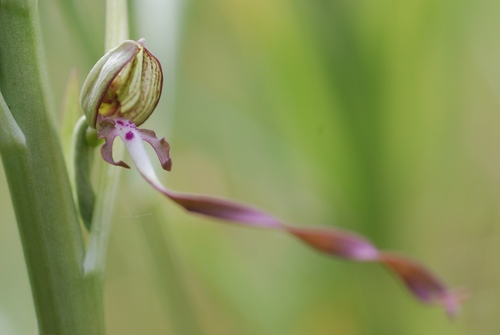
Himantoglossum hircinum (L.) Spreng. is a perennial glabrous herbaceous plant that grows up to 115 centimetres (45 inches) tall. It overwinters underground as a pair of ovoid or subglobose tubers, with short roots. Its leaves range from 5 to 20 cm long; basal leaves are larger than the leaves growing on the above-ground stem. Flowers are green-white, with a long twisted coiled labellum that may be tinged with white, green, purple or brown. The flowers have a strong scent similar to that of male goats. A closely related species with a similar appearance, Himantoglossum adriaticum, occurs in Eastern Europe. This orchid grows in dry meadows, rocky areas, and open woods. It most often occurs on south-facing grassy slopes, growing among Bromus and Brachypodium grasses. In France, it is frequently found growing along roadsides. In the United Kingdom, it grows at a maximum altitude of 850 m. Its range extends across Europe from Spain eastward to the Balkans, and it also grows in western North Africa. The species is usually rare, but can form large populations in habitats that suit it. Known sites that host the species include the sand dunes at Sandwich Bay in the United Kingdom, Massif Central in France, and the Mugello Valley in Italy. Himantoglossum hircinum is a food-deceptive orchid species, meaning its flowers generally do not provide nectar to their pollinators. The Botanical Society of Britain and Ireland notes that a small number of plants have been recorded producing nectar for pollinators, and it remains unclear which species are the principal pollinators of the lizard orchid, though the society suggests Andrena bees are the most likely main pollinators. It has been proposed that H. hircinum is a mycorrhizal generalist, but this claim has been questioned due to the species' limited natural distribution, and the question remains unresolved.