About Hilaria rigida (Thurb.) Benth. ex Scribn.
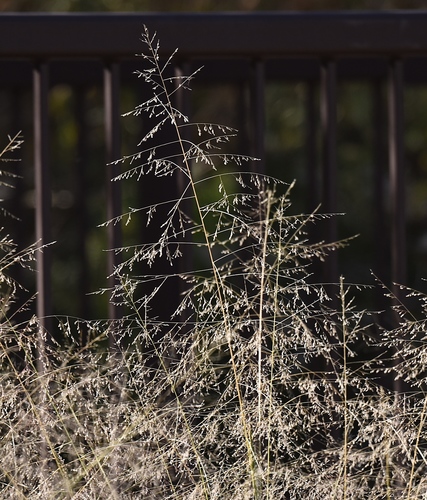
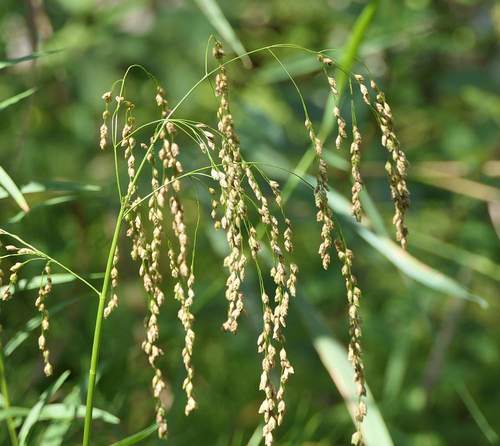
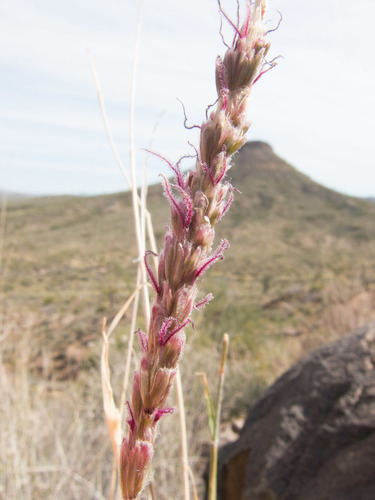
Hilaria rigida (formerly classified as Pleuraphis rigida), commonly called big galleta, is a species of clumping perennial monocot grass in the Hilaria genus of the grass family Poaceae. This grass is widespread in California deserts. After seed dispersal, it can be identified by the wiry, wavy flexuose inflorescence stalks that remain protruding from its clump of leaf blades. Unlike the hollow stems of most grasses, Hilaria rigida has solid stems even between its nodes. Its clumps can live more than 100 years, and the clumps naturally help to stabilize sand dunes. Botanist Philip A. Munz stated that it is said to be one of the most valuable forage grasses of the desert.
Big galleta grows in sand dunes, bajadas, scrublands, woodlands, and deserts, where it prefers dry, open, sandy to rocky slopes and flats. It grows on all soil types, but grows poorly in clay. It is tolerant of arid environments like desert floors, and it is the dominant grass in some desert scrub regions. It can be found growing from sea level up to around 1,600 meters (5,200 feet), and up to 1,220 meters (4,000 feet) in the Mojave Desert. It is common in creosote bush scrub, Joshua tree woodland, and blackbrush scrub plant communities, as well as areas with sandy soils such as the Kelso sand dunes. It is more common in the eastern Mojave Desert than its relative, galleta grass (Pleuraphis jamesii). It is a common native species ranging from the Mojave Desert and Sonoran Desert down to Sonora, Mexico, and can be found in California, Arizona, Colorado, Utah, and northern Mexico; it occurs less commonly in other parts of Mexico, and is rare in sand dunes in Utah's Washington and Kane Counties.
In desert dune habitats, the hummocky, clumpy growth form of this grass helps it stabilize loose, blowing sand. It acts as a nurse plant for seedlings of other species, such as cholla and barrel cactus; in turn, it receives protection from herbivory by growing near these spiny plants. It is not palatable to elk and waterfowl. Plant species commonly associated with Hilaria rigida include Larrea tridentata (creosote bush), Ambrosia dumosa (white bursage), Coleogyne ramosissima (blackbrush), Yucca brevifolia (Joshua trees), other Yucca species, Krameria erecta (range ratany), Krascheninnikovia (winterfat), Encelia farinosa (brittle bush), Ephedra species, Lycium andersonii (wolfberry), and Sphaeralcea (globemallow).
Big galleta is heavily grazed, and is considered valuable as fair to good forage for sheep and cattle. Philip A. Munz repeated that it is said to be one of the most valuable forage grasses of the desert. It resprouts after grazing when followed by rain, and its coarse texture and clumping growth habit help protect it from trampling. It is also used for erosion control and in revegetation projects.