About Hilaria mutica (Buckley) Benth.
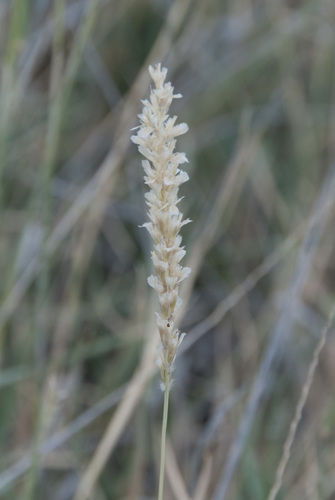
Hilaria mutica (Buckley) Benth. is a rhizomatous perennial sod-forming grass. It typically grows 30 to 60 cm (0.98 to 1.97 ft) tall, and may sometimes reach up to 90 cm (3.0 ft). Its stems have decumbent bases and erect tops. Most of its stiff, hairless leaves are basal, growing up to 15 cm (5.9 in) long. Stem bases grow from a thick, woody rootstock, and the plant's root system can penetrate up to 1.8 m (5.9 ft) deep into soil. The inflorescence is a few centimeters long, and can be white, straw-colored, or purplish. Spikelets are produced in clusters of three. This plant reproduces mainly by spreading via its rhizomes, and does not often produce viable seeds. It is susceptible to ergot. Hilaria mutica is one of the most common species found in regional semidesert grasslands. It is a climax species on frequently flooded lowlands, and also grows in upland areas. Habitat types where this grass occurs include pinyon-juniper woodland, mesquite, creosote, and grassy shrubsteppe. It grows best on land that floods for a few days then dries out, but it also grows in drier soils and is somewhat drought-tolerant. It grows on clay alongside honey mesquite and other species including burrograss (Scleropogon brevifolius), alkali sacaton (Sporobolus airoides), sacaton (S. wrightii), other dropseed grasses (Sporobolus spp.), grama grasses (Bouteloua spp.), muhly grasses (Muhlenbergia spp.), and tarbush (Flourensia cernua). Tobosa, the common name for this grass, is an important forage plant for cattle and horses in the American Southwest. It is productive and palatable until it becomes rough when it reaches maturity. It is especially valuable during drought, as it persists after other grasses die. It can be cut into hay while it is still green. In Texas, it yields 1000 pounds per acre, and this yield can be increased with careful, intentional management. In areas with adequate precipitation, burning is used to remove accumulated litter, which stimulates stems to produce more green growth. If the grass is infested with ergot fungus, eating it can cause ergot poisoning in grazing animals.