About Hieracium scabrum Michx.
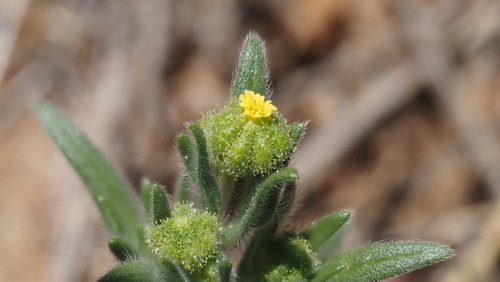
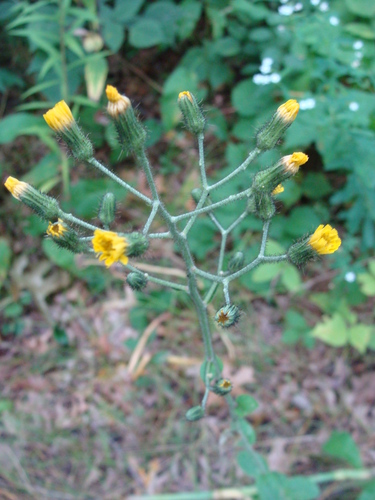
Hieracium scabrum Michx. is an herb that grows up to 60 cm (2.0 ft) tall, and is covered in many hairs that give it a rough texture when touched. Most of its leaves grow on the stem, with only a few leaves located at the base of the plant. Individual leaves can reach up to 120 mm (4.7 in) in length. A single stem can produce between 5 and 50 flower heads arranged in a conical or flat-topped cluster. Each flower head holds 30 to 60 yellow ray flowers, and has no disc flowers. Its flowering period runs from July to September. Hieracium scabrum is native to eastern and central parts of the United States and Canada, ranging from Nova Scotia west to Ontario, Minnesota, and Kansas, and south to Georgia and Oklahoma. It grows in sandy soil, and can be found in a range of habitats that includes human-disturbed anthropogenic habitats, meadows, fields, and woodlands. Little research has been done on floral-faunal relationships for Hieracium scabrum, but its flower heads are likely pollinated by long-tongued bees and other types of insects. It is suspected to act as a host plant for the species Schinia bina. Wild turkey and ruffed grouse are known to eat the seeds and leaves of Hieracium scabrum. Eastern cottontails and white-tailed deer occasionally browse the plant's foliage, but it is not a preferred food source: this is because of its hairy texture, and because it contains an unpalatable, bitter white latex.