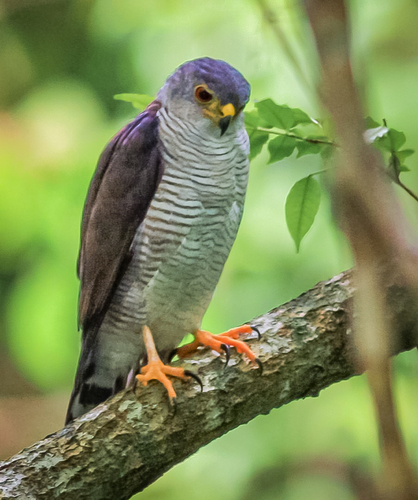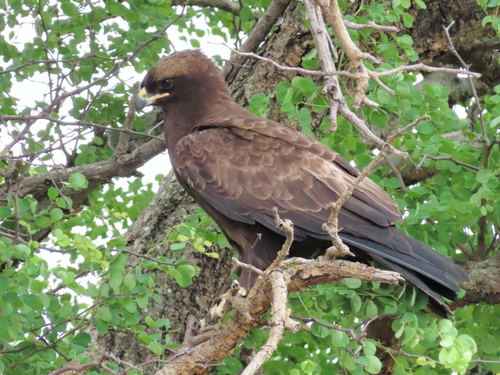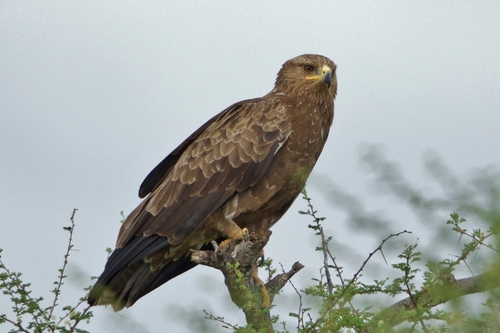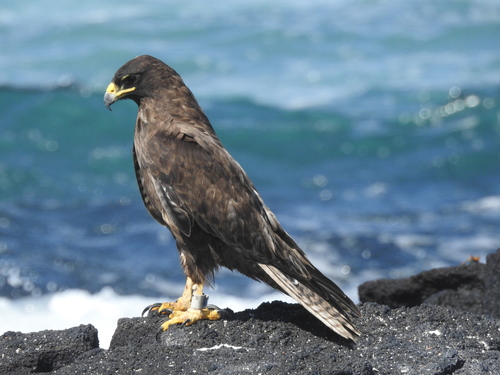
About Hieraaetus morphnoides (Gould, 1841)
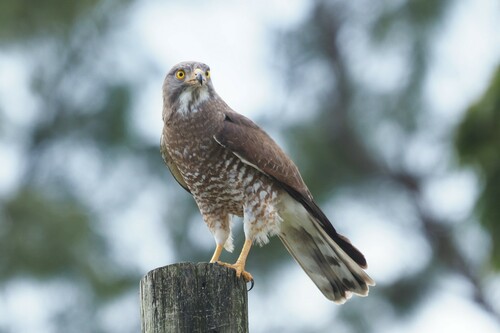
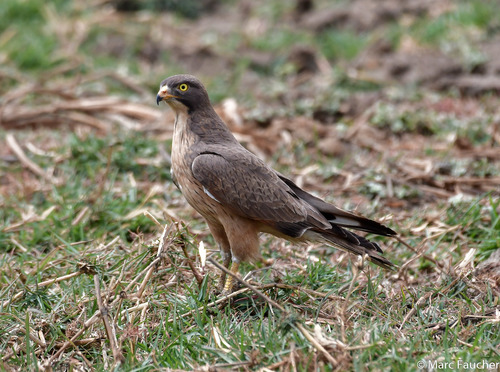
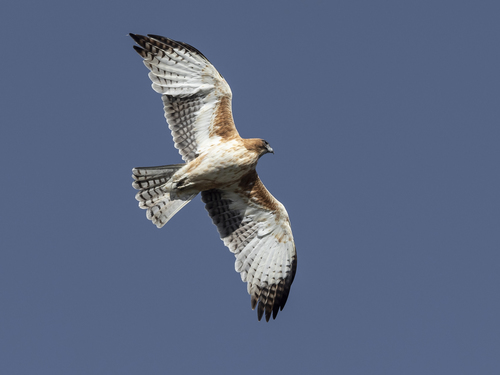
The little eagle, scientifically named Hieraaetus morphnoides (Gould, 1841), is a medium-sized bird of prey. It measures 45–55 cm (17–21.5 inches) in length, has a wingspan of around 120 cm, and an average weight of 815 g (1.8 lb), making it roughly the size of a peregrine falcon. Males have longer wings proportional to their bodies, but weigh nearly half as much as females. It has fully feathered legs and a square-cut, barred tail. It is a powerful bird; in flight it uses strong wing beats, glides on flat wings, and soars on slightly raised or flat wings. Little eagles come in light and dark colour forms, and their colour generally changes with age. The light form, which is the most common, has dark brown back and wings, black streaks on the head and neck, and a sandy to pale underbody. The dark form is similar, except its head and underbody are usually darker brown or rich rufous. The sexes have similar appearance, though females are larger and typically darker. Juveniles are similar to adults, but tend to be more strongly rufous with less contrast in their patterns. The little eagle has a large range across most of Australia, excluding the heavily forested parts of the Great Dividing Range. It tends to live in open woodland, grassland, and arid regions, and avoids dense forest. Higher populations of the species are associated with hillsides that have a mix of wooded and open areas, such as riparian woodlands, forest margins, and wooded farmland. Little eagles typically use trees as lookouts while hunting in open woodland. In the Australian Capital Territory (ACT), little eagles frequently live in open woodland and riparian areas. Like many Australian native species, the little eagle has a deteriorating population caused by habitat loss and competition from other species. A major factor in its decline is the drop in rabbit populations following the release of the calicivirus; the eagle came to rely heavily on rabbits after the extinction and massive decline of native terrestrial mammals of rabbit size or smaller, including large rodents, bandicoots, bettongs, juvenile banded hare-wallabies, and other wallabies. In the first national Australian bird atlas, conducted from 1977 to 1981, the little eagle was reported in 65% of one-degree grid cells across Australia, with mostly high reporting rates (more than 40% of surveys per grid) across New South Wales and Victoria. Breeding was recorded in 11% of grid cells, with the highest rates in New South Wales (NSW) and Victoria. In the second national bird atlas, conducted from 1998 to 2002, the little eagle was recorded in 59% of grid cells, with mostly low reporting rates (recorded in less than 20% of surveys per grid). Breeding was recorded in 5% of grid cells. Overall, the national reporting rate for the little eagle declined by 14%. In NSW, the reporting rate declined by 39% over the last 20 years (two little eagle generations), and by 50% over the past 30 years, with an accelerating decline since the 1990s. The decline in reporting rate over the past 20 years has been greater than 20% in the South Eastern Highlands bioregion, which includes the ACT. The little eagle was once common in the ACT, but has undergone a decline of more than 70% over the last 20 years. In the late 1980s, there were an estimated 13 breeding pairs in the ACT, mostly in the northern half of the territory with the highest concentrations in the Murrumbidgee and Molonglo river corridors. By 2005, the only confirmed breeding record in the ACT was an unsuccessful nest near Uriarra Crossing. A more intensive survey of the ACT in 2007 found three breeding pairs that fledged a total of four young. In 2008, four breeding pairs were recorded and four young were fledged. In 2009, three breeding pairs were recorded and three young were fledged. Little eagles nest in open woodland, usually on hillsides, and along tree-lined watercourses. Nests are typically placed in a mature, living tree. The birds build stick nests lined with leaves, and may use different nests in successive years, including nests built by other birds such as crows. A pair of little eagles only reproduces once per year, and each pair produces only one or two eggs per breeding season, usually laid in late August to early September. After an incubation period of around 37 days, one or two young fledge after approximately eight weeks. Little eagles reach breeding maturity after two to three years, which leaves a large portion of the population made up of juvenile eagles; mature eagles make up less than three-quarters of the total population. Little eagles defend their nesting territories against intruders and advertise them through soaring, undulating flight displays, conspicuous perching, and/or calling. Individual movement behaviour varies: little eagles may be partly migratory as altitudinal migrants, dispersive, or permanently resident. They tend to leave the area at the first sign of human intrusion.