About Hieraaetus ayresii (Gurney, 1862)
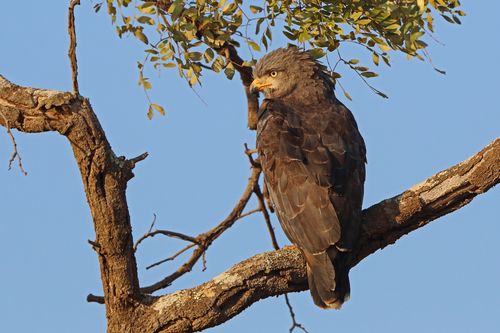
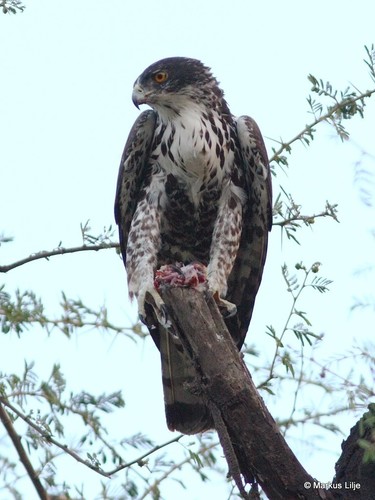
The adult male Ayres's hawk-eagle (Hieraaetus ayresii) has blackish upperparts mottled with white, and typically has a white forehead and supercilium. Its upper-wing coverts match the coloration of the upperparts. The tail is ashy grey with a broad black tip and three to four narrower dark bars; primary and secondary feathers are black. The underparts are white, with heavy dark brown spots and blotches on the breast and belly, which become sparser on the thighs and vent. The legs are well-feathered and pure white. Under-wing coverts are brown with white markings, while the underside of the flight feathers is dark, heavily barred, and has no noticeable grey patch. The eyes range from yellow to orange; the cere and feet are yellow; the bill is bluish horn-colored, paler toward the base, with a black tip. This species has a small crest that can be prominent at times. Males are smaller than females, darker, usually have more densely spotted underparts, and less white on the forehead and supercilium. There are two color phases: the normal phase described above, and a melanistic phase that is mostly black with white markings. Juvenile Ayres's hawk-eagles are dark brown on the back, wing coverts, and crown, with a slightly paler neck. They are largely white below from the throat to the crissum and legs, with sparse variable dark brown markings along the chest, belly, and flanks. As they mature, young hawk-eagles often develop a duskier, browner color with a faint rufous cast on the underparts before molting into full adult plumage. This species is most often confused with the African hawk-eagle, which is larger and lankier, with a more protruding head, longer tail, more sparsely marked underparts, and more heavily marked wings with a white window above. It shares white "landing lights" at the front of the wings with the similarly sized booted eagle, but booted eagles usually have very different overall markings (either paler and browner, or all dark in dark morphs). Similarly sized black sparrowhawks are also sometimes confused with this species, but sparrowhawks have very different body proportions and bare, dull green-yellow legs. Ayres's hawk-eagle is a medium-sized raptor and quite a small eagle, with a body mass roughly equal to that of a peregrine falcon, though it has a slightly greater total length and a wingspan similar to a common buzzard. Its total length ranges from 44 to 57 cm (17 to 22 in), and its wingspan ranges from 106 to 137 cm (3 ft 6 in to 4 ft 6 in). Recorded weights from a small sample are 615 to 714 g (1.356 to 1.574 lb) for males, and 879 to 1,150 g (1.938 to 2.535 lb) for females. The average weight of four adult males was 662.5 g (1.461 lb), while the average weight of 10 adult females was 1,017.5 g (2.243 lb). Juveniles are around 5% lighter than adults, despite having slightly larger wings. Wing chord measures 326 to 345 mm (12.8 to 13.6 in) for males and 360 to 420 mm (14 to 17 in) for females. Tail length is 175 to 185 mm (6.9 to 7.3 in) for males and 205 to 223 mm (8.1 to 8.8 in) for females. Tarsus length is 56 to 62 cm (22 to 24 in) for males and 65 to 80 cm (26 to 31 in) for females. The species shows strong sexual dimorphism, with females larger than males, and no overlap in standard measurements between smaller males and larger females. Bill length ranges from 20 to 31 mm (0.79 to 1.22 in), averaging 21.3 mm (0.84 in) in males and 25.4 mm (1.00 in) in females. The enlarged hallux claw on the rear toe measures 27.9 to 36.3 mm (1.10 to 1.43 in), averaging 29.5 mm (1.16 in) in males and 34.4 mm (1.35 in) in females, which is quite large for an eagle of this small size. Ayres's hawk-eagle has a patchy distribution across sub-Saharan Africa, ranging from Sierra Leone east to Somalia, and south to northern Namibia and northeastern South Africa. Its core range extends from southern Democratic Republic of the Congo and southern Uganda south through almost all of Kenya, Tanzania, Zambia, and Mozambique, as well as most of Angola, to northeastern Namibia, northern Botswana, and northern Zimbabwe. During the rainy season, it moves out of the denser, taller deciduous woodlands of central Africa into more open but still wooded savanna further south, and probably into coastal East Africa; emerging rain-season foliage turns open woodland into denser forest and tree savanna into woodland in its original range. After moving south, it may enter towns in South Africa to hunt doves and feral pigeons. A similar north-to-south movement is expected in West Africa, where the species has been recorded as a vagrant as far west as Senegal and Gambia, though this record is unconfirmed. In its core south-central African range, it typically occurs in woodlands dominated by Brachystegia and Baikiaea. It is not usually a forest-dwelling species, and prefers mature woodland located on often irregular, rocky terrain. Occasionally, it may occupy Acacia plantations and riparian zones, but this is not regular. It is rarely found in hyper-arid and treeless areas.