About Hibiscus waimeae A.Heller
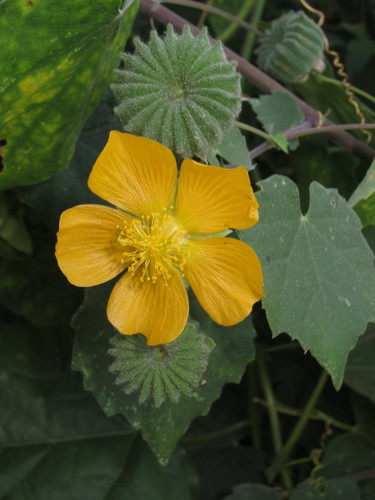
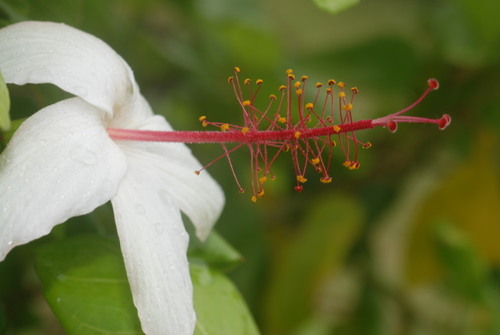
Hibiscus waimeae A.Heller is a small tree with gray bark, reaching an average height of 6–10 metres (20–33 ft) and an average trunk diameter of 0.3 m (0.98 ft). Its fuzzy brown seeds are roughly 1/8 of an inch long, and are enclosed inside protective oblong pods. This species blooms year-round, though it may have brief non-blooming periods, especially during cooler seasons. Each individual flower only lasts for one day: it opens white, and fades to pink by the afternoon. While individual flowers complete their bloom and fade cycle in one day, the whole plant can live for more than 5 years. Along with H. arnottianus, which grows on Oʻahu and Molokaʻi, H. waimeae is one of the only two Hawaiian hibiscus species that produce white flowers. H. waimeae also produces sweetly scented flowers, and is one of only two fragrant hibiscus species overall.
In terms of distribution and habitat, H. waimeae grows in coastal mesic, mixed mesic, and wet forests at elevations between 250 and 1,200 m (820–3,940 ft). The nominate subspecies, H. waimeae subsp. waimeae, occurs in the western and southwestern parts of Kauai, where it grows in the Waimea Canyon area and ocean-facing valleys. The other subspecies, H. waimeae subsp. hannerae, is rarer and is listed as endangered by the US Fish and Wildlife Service; it is most often found in northwestern Kauai, growing in the Hanakapiʻai, Limahuli, and Kalihi Wai valleys.
For uses, like many other hibiscus species, Hibiscus waimeae flowers are popularly worn in the hair or tucked behind the ear. It is also commonly used to make leis, which are flower garlands strung together for use in many different types of celebrations. Historically, Native Hawaiians grew this plant primarily around homes for use as decoration. It is also reported that men and boys ate H. waimeae flowers as a laxative.
In cultivation, because hibiscus plants hybridize easily, it is recommended that seeds of this species are hand pollinated after being removed from their pods. H. waimeae can be propagated through four methods: seeds, cuttings, air layering, and grafting.