About Hibiscus moscheutos subsp. lasiocarpos (Cav.) O.J.Blanch.
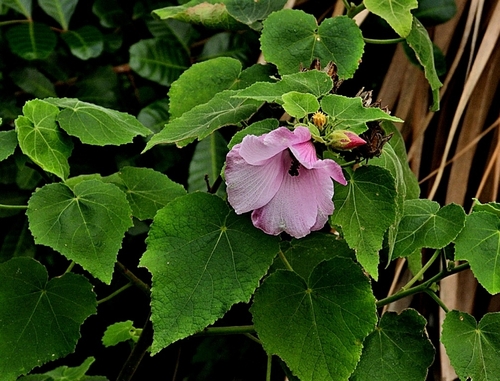
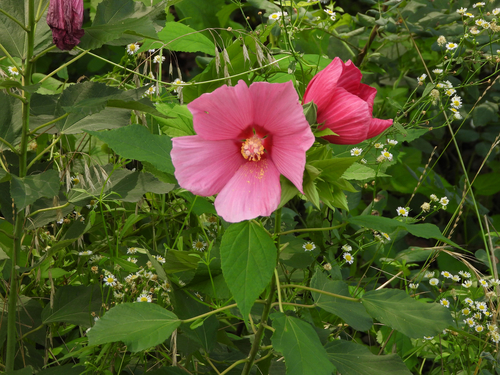
Hibiscus moscheutos, commonly called rose mallow, swamp rose-mallow, crimsoneyed rosemallow, or eastern rosemallow, is a flowering plant species belonging to the family Malvaceae. It is a cold-hardy perennial wetland plant that often grows in large colonies. Its hairy (hirsute) leaves vary in shape, but are most commonly deltoidal with up to three lobes. It occurs in wetlands and along river systems of the eastern United States, ranging from Texas to Atlantic coastal states, with its range extending north into southern Ontario. Many naturally occurring forms of this species exist. It is a tall plant, reaching heights of 1.5–2.5 metres (4.9–8.2 ft), and produces flowers that can grow up to 20 centimetres (7.9 in) across. Petal colors vary from pure white through multiple shades of pink to deep red, and most flowers have a deep maroon colored center eye. There is no taxonomic consensus on the formal nomenclature of its multiple recognized subspecies. Unlike the related species Hibiscus laevis, which produces buds and blooms along its stem, Hibiscus moscheutos bears its flowers at the apex of stems. In ecological terms, Hibiscus moscheutos acts as a larval host plant for the common checkered skipper, the gray hairstreak, the Io moth, and the pearly wood nymph. Edible parts of the plant include leaf buds, young leaves, flowers, immature seed pods (which can be prepared in the same way as okra), seeds, and roots. The leaves and roots contain mucilage. A tea made from boiled leaves has been used to relieve cough, sore throat, and digestive inflammation; these medicinal properties have also been used to treat dysentery, lung conditions, and urinary infections. An infusion made from dried stalks has been used to treat bladder infections. Externally, Hibiscus moscheutos flowers have been used to reduce swelling and pain caused by bruises and insect stings. Hibiscus moscheutos is a popular garden plant. It can be propagated by seed, by dividing crowns during winter dormancy, and with limited success from hard-wood stem cuttings. Commercial nurseries have released many hybrids developed from native North American Hibiscus species. Both the pure species and its hybrids are grown in cultivation for use in bog gardens and other water features. They are ornamental and provide wildlife value for nectar-feeding animals and birds.