About Hexaprotodon liberiensis (Morton, 1849)
Body Form Similarity
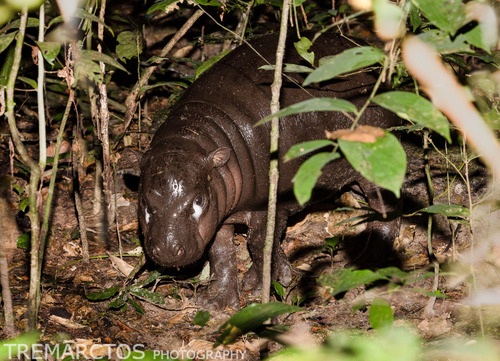
Pygmy hippopotamuses (Hexaprotodon liberiensis) share the same overall body form as common hippopotamuses. They have a graviportal skeleton, four stubby legs, four toes on each foot, and support a portly body frame.
Size Comparison With Common Hippos
However, pygmy hippos are only half as tall as common hippos, and weigh less than one quarter as much as their larger relative. Adult pygmy hippos stand 75–100 cm (2.46–3.28 ft) high at the shoulder, measure 150–175 cm (4.92–5.74 ft) in length, and weigh 180–275 kg (397–606 lb).
Lifespan
In captivity, their lifespan ranges from 30 to 55 years, though they are unlikely to live this long in the wild.
Skin Coloration
Their skin is greenish-black or brown, fading to a creamy gray on their lower body.
Skin Structure
Pygmy hippo skin is very similar to common hippo skin: it has a thin epidermis over a several-centimeter-thick dermis. Like common hippos, pygmy hippos produce an unusual secretion that gives their bodies a pinkish tinge.
Skin Secretion
This secretion is often called "blood sweat," though it is neither sweat nor blood. The substance, called hipposudoric acid, is thought to have antiseptic and sunscreening properties.
Aquatic Skin Adaptation
Hippo skin dries out quickly and cracks easily, which is why both species spend so much time in water.
Skeleton Structure
The pygmy hippopotamus skeleton is more gracile than the common hippopotamus skeleton, meaning their bones are proportionally thinner. The common hippo's spine runs parallel to the ground, while the pygmy hippo's back slopes forward — this is likely an adaptation to move more easily through dense forest vegetation.
Limb and Head Proportions
In pygmy hippos, the legs and neck are proportionally longer, and the head is proportionally smaller. Pygmy hippos have much less prominent eye sockets and nostrils, an adaptation to their habit of spending less time in deep water; more prominent eye sockets and nostrils help common hippos breathe and see while mostly submerged.
Foot Structure
Pygmy hippo feet are narrower, but their toes are more spread out and have less webbing, which helps them walk on the forest floor.
Aquatic Adaptations
Despite being adapted for a more terrestrial lifestyle than common hippopotamuses, pygmy hippos are still more aquatic than all other terrestrial even-toed ungulates. Their ears and nostrils have strong muscular valves to help them submerge underwater, and their skin physiology depends on access to water.
Breeding Behavior Study Limitation
No study of wild pygmy hippo breeding behavior has ever been conducted, so observed breeding behavior in captive zoo pygmy hippos may differ from their natural behavior.
Sexual Maturity
Pygmy hippopotamuses reach sexual maturity between three and five years of age. The youngest recorded age for a first birth is three years and three months, from a pygmy hippo at Zoo Basel in Switzerland.
Oestrus Cycle
The oestrus cycle of a female pygmy hippo lasts an average of 35.5 days, with the oestrus period itself lasting 24 to 48 hours. Pygmy hippos pair up to mate, but the length of this relationship is unknown.
Mating Behavior
In zoos, they breed as monogamous pairs. Copulation can happen on land or in water, and a pair will mate one to four times during a single oestrus period.
Captive Breeding Seasonality
In captivity, pygmy hippos are conceived and born in all months of the year.
Gestation and Birth
The gestation period ranges from 190 to 210 days, and usually only one calf is born, though twins have been recorded. Common hippopotamuses only mate and give birth in water, but pygmy hippos mate and give birth on both land and water.
Newborn Development
Young pygmy hippos can swim almost immediately after birth. At birth, pygmy hippos weigh 4.5–6.2 kg (9.9–13.7 lb); male newborns are about 0.25 kg (0.55 lb) heavier than female newborns.
Weaning Process
Pygmy hippos are fully weaned between six and eight months old. Before weaning, calves do not follow their mother when she leaves the water to forage, and instead hide alone in the water.
Suckling Behavior
The mother returns to the hiding spot around three times a day and calls for her calf to suckle. Suckling happens while the mother lies on her side.



