About Hexalobus monopetalus (A.Rich.) Engl. & Diels
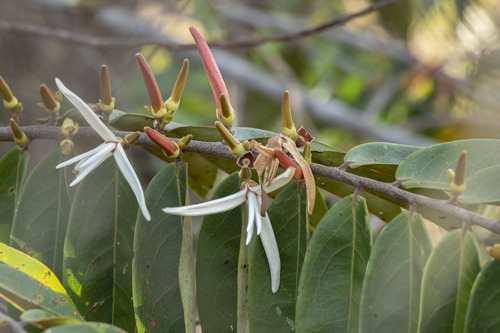
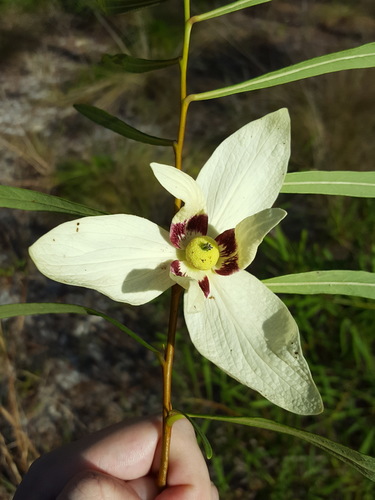
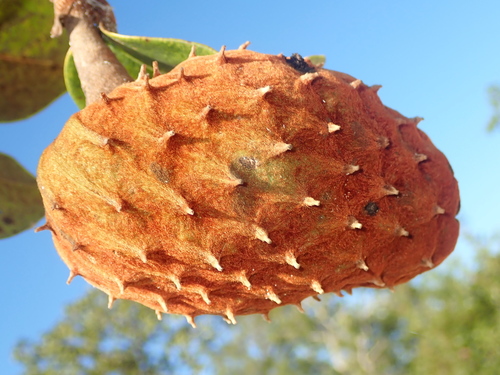
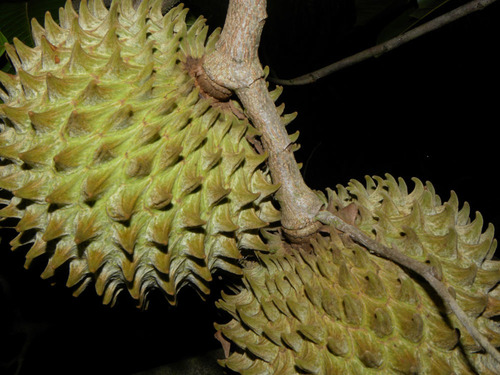
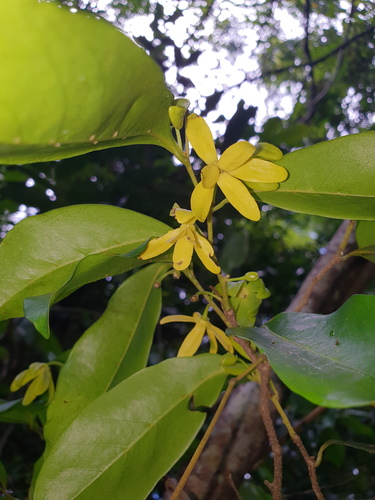
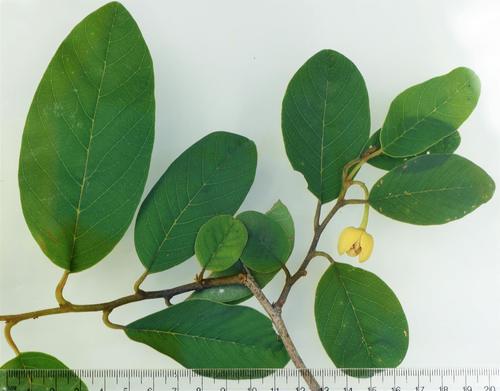
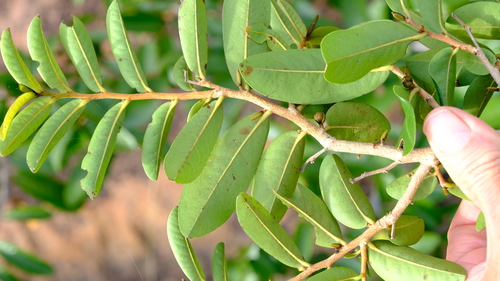
Hexalobus monopetalus is a bush or small tree that grows up to 15 meters (49 feet) tall. It may have multiple stems, with an either upright or spreading growth habit, and its lowest branches can lie along the ground. Its bark is gray, with texture that varies from smooth to rough to flaky. Its petioles measure 1–4 by 1.2 millimeters, with a channel along their upper surface. The petioles are covered in 0.2-0.3 millimeter long, curly, light-colored hairs. Its leaves are oblong to elliptical in shape, with a texture ranging from papery to slightly leathery; they measure 3.6-17.5 by 1.2-6.5 centimeters, with rounded to shallowly pointed tips that are sometimes slightly notched, and rounded to wedge-shaped bases. The upper surfaces of the leaves are slightly glossy, ranging from hairless to sparsely covered in 0.3 millimeter long cream-colored hairs. The undersides of the leaves range from hairless to densely covered in 0.2-0.8 millimeter long straight to curly hairs. The leaves have 6–15 pairs of secondary veins that branch off the midrib at 50°–80° angles, arching and connecting to each other near the leaf margins. Its fragrant flowers grow in clusters of 1–3, emerging among leaves, on twigs, or directly from the trunk. Flowers are borne on short peduncles that measure 2 by 2 millimeters. The peduncles have 5–6 oval, concave bracts that reach up to 5 by 3.5 millimeters. At maturity, peduncles are covered in dense 0.3 millimeter long cream to rust-colored hairs. Its oval to round flower buds are 3-5 millimeters in diameter. Its flowers have 3 broadly oval, concave sepals that measure 4–7 by 3.5–5 millimeters, and are fused at the base. The outer surfaces of the sepals are covered in silky hairs, while the inner surfaces are wrinkled. Its flowers have 6 petals arranged in two rows of three. The light-yellow petals are fused at their base to form a tube, with narrow, lance-shaped lobes. The base of the floral tube is 2.5-4 millimeters long. The lobes measure 9–27 by 3–7 millimeters, with irregular folds and shallowly pointed to rounded tips. The margins of the inner petals curve back to form hollow chambers inside the basal tube. The outer surface of the corolla is covered in 0.1 millimeter-long white silky hairs, which become 0.2 millimeter-long rust-colored silky hairs at the base. The inner surface of the corolla is covered in short hairs, except for the hairless base. Its flowers have numerous oblong stamens that measure 1.4-2.1 by 0.5-0.8 millimeters. The connective tissue between the anther lobes extends upward to form a disc-shaped cap. Its flowers have 2–7 carpels that measure 2.1-3 by 0.8-1 millimeters, and are covered in dense gold to rust-colored hairs. Its bilobed stigmas are 1-1.3 millimeters long. Its brilliant red, elliptical to cylindrical fruits grow in groups of 1–5 and measure 2.2-4.6 by 1.3-2.2 centimeters. The fruit surface can be constricted around its seeds, and ranges from warty to wrinkled. Fruits are covered in short hairs, and contain light-colored pulp. Fruits hold 2–11 brown, flat, elliptical to oval seeds that measure 10–15 by 7-10 millimeters, arranged in 1–2 rows. Hexalobus monopetalus has been observed growing in savanna forest corridors, at elevations from 0 to 1,600 meters (5,200 ft). It prefers sandy soil or dry rocky substrates. Bioactive molecules extracted from its fruit have been reported to have antifungal activity in tests with Candida albicans.