About Heteroxolmis dominicana (Vieillot, 1823)
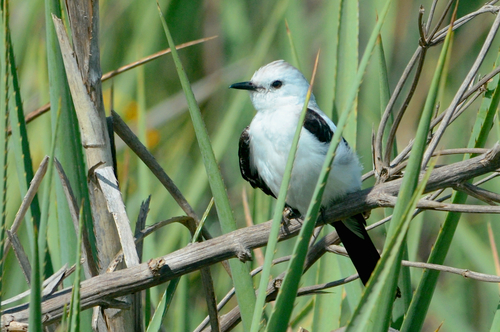
The black-and-white monjita, with the scientific name Heteroxolmis dominicana (Vieillot, 1823), is 20 to 20.5 cm (7.9 to 8.1 in) long. Adult males are mostly white: they have pale grayish smudging on the head and back, black wings with white outer thirds of the primaries, a long black tail, and entirely white underparts. Adult females have a brownish gray crown and back, white scapulars, and a white rump. Both sexes share a dark iris, a black bill, and black legs and feet. Juveniles have a rusty back. This species has a patchy distribution. It occurs in the Brazilian states of Paraná, Santa Catarina, and Rio Grande do Sul, in Uruguay, and in northeastern Argentina south to northeastern Buenos Aires Province. The SACC holds unconfirmed records from Paraguay and classifies the species as hypothetical in that country. The black-and-white monjita inhabits a variety of landscapes. It is primarily found in marshes and bogs that are characterized by Cypernus and Eryngium sedges. It also occurs in open or burned areas, and locally on the landward side of coastal sand dunes. It forages in grasslands that adjoin these wetter areas. In terms of elevation, it mostly ranges from sea level to 500 m (1,600 ft), but is occasionally found much higher.