About Heteropterus morpheus (Pallas, 1771)
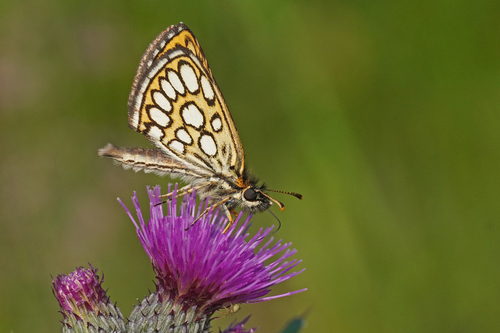
Heteropterus morpheus (Pallas, 1771) has a forewing length of 15–18 mm. This butterfly has a very distinctive and attractive wing underside, and a drab wing upperside. The upperside is rarely seen, because the species usually settles with its wings closed. The upperside is quite dark brown. The underside is the characteristic surface: the brown forewings are partially covered by the hindwings, and the visible portion of the forewings shares the same patterning as the hindwings. On an ochre background, there are three rows of white oval spots, each surrounded by black, plus a white border edged with black. In Seitz's description, H. morpheus Pall. (= steropes Schiff.) (87 b) has a black forewing upperside with 3 apical dots and one spot each in cellules 4 and 5. Some females have a row of 4 or 5 yellow dashes on the hindwing, plus a small dot in the cell. On the underside, the forewing has a spot in the cell, another spot proximal to the apical dots, and a narrow short band near the margin. The hindwing has three rows of oval mother-of-pearl spots, each surrounded by small yellow spots, and a narrow yellow band near the margin. This butterfly is called "mirror" because of its mother-of-pearl spots. Its distribution spans Europe and Asia, extending east as far as Japan. In France, it has been recorded in the southwest, including the Hautes-Pyrénées department in 2011. Adults are in flight from June to August, varying by location. The species' flight pattern is just as distinctive as its appearance, and allows immediate identification: the butterfly appears to bounce through the air with little clear direction, almost as if it were drunk. The larvae feed on plants of the genera Eriophorum, Poa, Calamagrostis, Brachypodium and Molinia, including the species Molinia coerulea (also known as Poa annua and Calamagrostis canescens).