About Heteronympha cordace (Geyer, 1832)
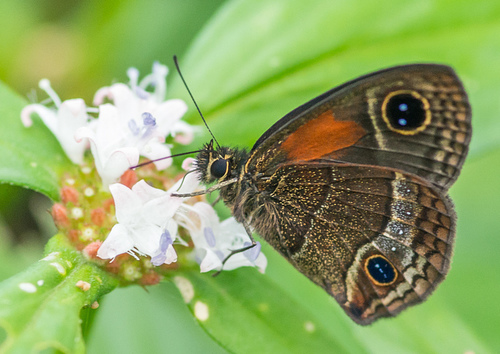
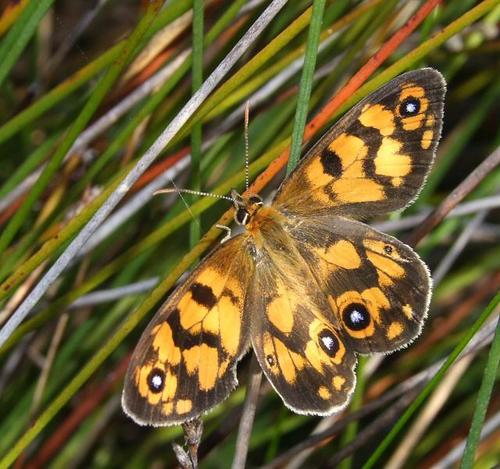
Heteronympha cordace (Geyer, 1832) has a wingspan of 38–42 mm (1.5–1.7 in). Females are generally larger than males and have stouter abdomens. The uppersides of its wings are black to dark brown, marked with orange to brownish-orange markings. These markings include two blue-centered black eyespots: one subapical and a larger subtornal. The underside of the wings is a lighter shade and has more extensive orange areas. This butterfly lives in disjunct populations across Australia, found in New South Wales, southern Victoria, southeastern South Australia, and Tasmania. Its populations occupy swampy areas ranging from the alpine regions of the Great Divide to coastal areas in both eastern and western parts of its range. It is not common anywhere, its colonies tend to stay in place, and many populations have gone extinct due to habitat loss. Adult Heteronympha cordace fly slowly in a meandering path close to the ground, among their larval host plants and near the food plants Melaleuca and Leptospermum that grow near their breeding habitat. The species completes one generation per year, with adults active mainly from late December to February. It prefers sedgeland and low shrubland in swamps and along creeks, often where the larval food plant grows in dense stands. It mostly occurs at altitudes between 600–1,800 m (2,000–5,900 ft), but can be found as low as sea level in Tasmania. The larval food plant of Heteronympha cordace is Carex appressa. Females lay a single egg or very few eggs on the underside of the lower leaves of Carex appressa. The eggs are 0.8 mm (0.031 in) in diameter, green, nearly spherical, and marked with thin longitudinal ribs. Fully grown larvae are green to greenish brown and generally 25 mm (0.98 in) long. Larvae have a darker middorsal line, with paler dorsolateral and lateral lines. Their heads are slightly concave and range in color from reddish brown to mottled brown. The pupa is green with greenish-yellow wings, and measures about 14 mm (0.55 in) long. Pupation takes place either on a low leaf of the host plant or near the host plant; the pupa hangs head downward, held in place by its cremaster.