About Heteronetta atricapilla (Merrem, 1841)
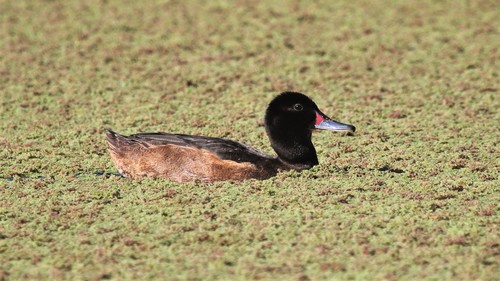
The black-headed duck (Heteronetta atricapilla) is the most basal living member of its subfamily. It lacks the stiff tail and swollen bill that its relatives have, and overall closely resembles a fairly typical diving duck. Its plumage and other unique features suggest it may not be a very close relative of other stiff-tailed ducks, and instead may be the product of convergent evolution from the ancestors of stiff-tailed ducks. The black-headed duck reaches about 35 cm (14 in) in length. Males have an average weight of about 510 g (18 oz), while females average 565 g (20 oz). The species has a distinctive body shape, with a long body and disproportionately short wings. Its bill has a black upper mandible (maxilla) and an orange lower mandible (mandible); during the breeding season, the maxilla has a rosy patch at its base. Adult males have a glossy black head and upper neck, and a white chin. Their upperparts are deep brownish black with cinnamon or pale rufous speckles and vermiculation. The folded wing displays two white bars. Their underparts are whitish with brown mottling, and have a silvery appearance. Adult females have a dark brown head and neck and a whitish throat, and are otherwise identical in appearance to males. Immature birds are similar to females, but have more rufous upperparts, more yellowish underparts, and a pale eye stripe. The black-headed duck has two separate distribution ranges. One range is along the western side of central Chile. The other extends from extreme southern Bolivia south through central Paraguay to central Argentina, and east through southern Uruguay into southernmost Brazil. Undocumented sight records in the Falkland Islands lead the South American Classification Committee of the American Ornithological Society to classify the species as hypothetical there. It mostly inhabits freshwater marshes dominated by the sedge Scirpus californicus; outside the breeding season, it may also be found in lakes, water-filled ditches, and sometimes flooded fields.