About Heteromeles arbutifolia (Lindl.) M.Roem.
Toyon, scientifically named Heteromeles arbutifolia (Lindl.) M.Roem., is also commonly known as Christmas berry and California holly.
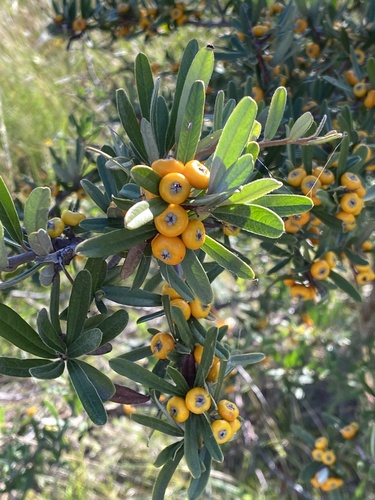
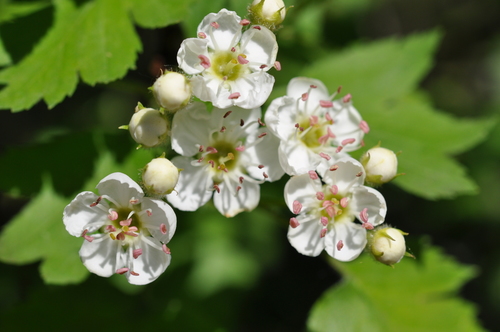
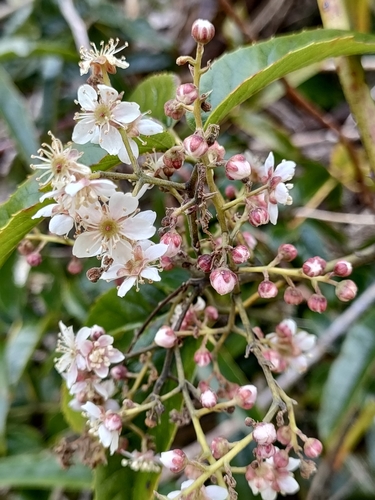
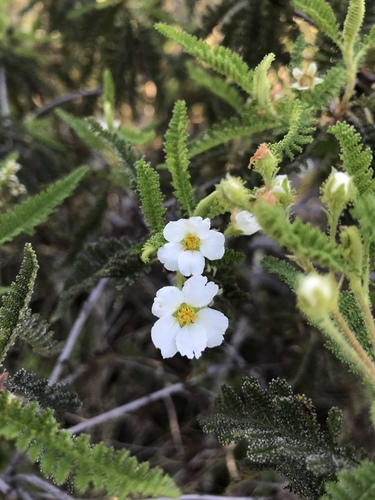
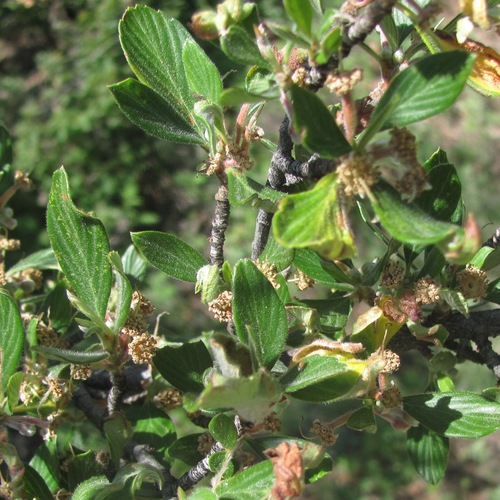
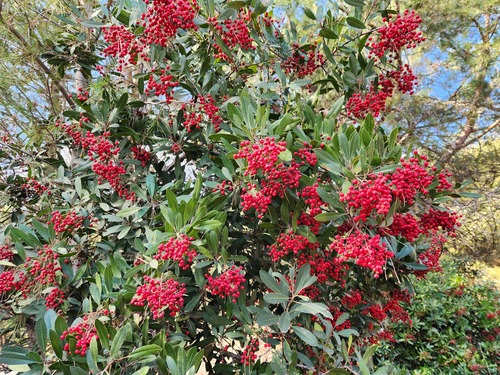
Toyon typically grows 2–5 metres (6+1⁄2–16+1⁄2 ft) tall, and rarely reaches up to 10 m when growing in shaded conditions, with a rounded to irregular canopy. Its leaves are evergreen, alternate, sharply toothed, and borne on short petioles. Individual leaves measure 5–10 centimetres (2–3+7⁄8 in) long and 2–4 cm (3⁄4–1+1⁄2 in) wide. In early summer, it produces small white flowers that are 6–10 millimetres (1⁄4–3⁄8 in) in diameter, arranged in dense terminal corymbs; flowering peaks in June, and each flower has five rounded petals. The fruit is a small, bright red, berry-like pome 5–10 mm across, produced in large quantities. The pomes mature in fall and persist on the plant well into winter.
This species is native to extreme southwest Oregon, California, and the Baja California Peninsula. It is a prominent component of the coastal sage scrub plant community, and also grows in drought-adapted chaparral and mixed oak woodland habitats.
Butterflies visit toyon plants, which give off a mild, hawthorn-like scent. Its fruit is eaten by birds including mockingbirds, American robins, cedar waxwings, and hermit thrushes. Mammals such as coyotes and bears also eat the pomes and disperse their seeds.
Toyon pomes are acidic and astringent, and contain a small amount of cyanogenic glycosides, which break down into toxic hydrocyanic acid during digestion. The toxic compounds are removed by mild cooking. Most fruits from plants in the Rosaceae family, including apples, apricots, peaches, cherries, and plums, contain cyanide. A 2016 study found 5 grams of dried toyon berries, used as an Alzheimer's treatment, to be safe; the study also detected no cyanogenic compounds in the plant.
Toyon has different common names across Indigenous tribes and linguistic groups: it is called ashuwet by the Tongva and ʔívil̃uqaletem, and qwe' in the Barbareño, Cruzeño, and Inseño Chumashan languages. The pomes served as food for local Native American tribes including the Chumash, Tongva, and Tataviam, and can be made into jelly. Most often, pomes were dried and stored, then later cooked into porridge or pancakes. Californian tribes often cooked the fruit over fire to remove its slightly bitter taste. The Tongva ate the berries fresh, boiled and left them in an earthen oven for 2 to 3 days, roasted them, or made them into cider. Pulverized toyon flowers steeped in hot water made a tea to ease gynecological ailments. For stomach pains, bark and leaves steeped in hot water made a tea; this same tea could also act as a seasonal tonic and ease other body pains. Mashed ashuwet applied to soothes eases pain, and an infusion of bark and leaves is used to wash infected wounds. The ʔívil̃uqaletem commonly consumed the fruit both raw and cooked. Later European settlers added sugar to toyon fruit to make custard and wine.
In cultivation, toyon can be grown in domestic gardens in well-drained soil, and is cultivated as an ornamental plant as far north as Southern England. It can survive minimum temperatures as low as −12 °C (10 °F). Its bright red winter pomes, which birds often eat voraciously, are showy and ornamental. Like many other genera in the Rosaceae tribe Maleae, some toyon cultivars are susceptible to fireblight. It survives with very little water, making it suitable for xeriscape gardening, and it is less of a fire hazard than many other chaparral plants.