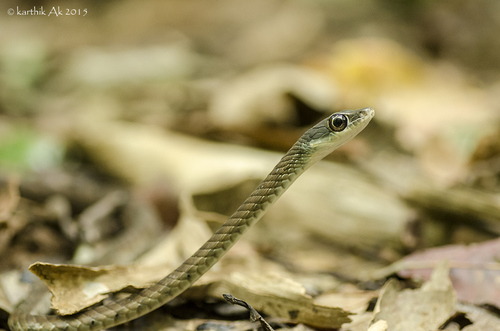
About Heterodon platirhinos Latreille, 1801
Etymology of the scientific name: The generic name Heterodon comes from Greek words heteros, meaning "different," and odon, meaning "tooth." The specific name platirhinos comes from Greek words platys, meaning "broad or flat," and rhinos, meaning "snout."
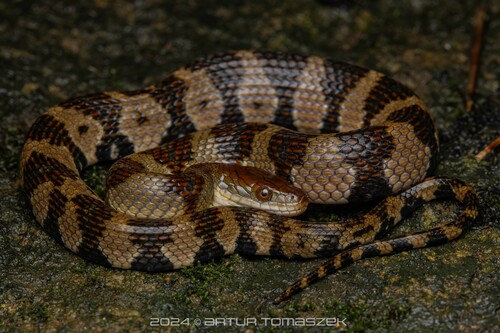
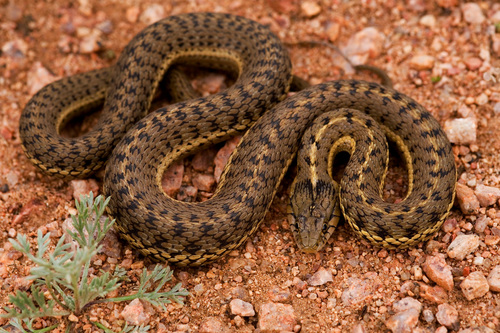
This species of snake has a quite stout body. Its color pattern is extremely variable: it can be red, green, orange, brown, gray, black, or any combination of these colors, depending on locality. Dorsally, it may be blotched, checkered, or patternless. Its belly is usually a solid gray, yellow, or cream color, and the underside of its tail is lighter than its belly. Its most distinguishing feature is an upturned snout, which it uses to dig in sandy soils.
The average adult total length (including tail) of H. platirhinos is 71 cm (28 in), and females are larger than males. The maximum recorded total length for the species is 116 cm (46 in).
H. platirhinos has a wide geographic range, extending from the central United States to the east coast of North America. In the northern portion of its range, it occurs in southern Ontario, southern New Hampshire, Minnesota, Wisconsin, and Massachusetts. To the west, it can be found in Texas and Kansas. The southern edge of its range reaches southern Florida. Population densities decline as the species approaches the northern limits of its range.
This snake prefers upland sandy pine forests, old fields, and forest edges. Like most members of the genus Heterodon, the eastern hognose snake favors dry habitats with loose soil suitable for burrowing; loose soil is also preferred for nesting and egg laying. Barrier beach and dune ecosystems support some of the highest population densities of Heterodon platirhinos, due to abundant prey that primarily consists of anurans from the genus Anaxyrus. At the northern end of its range, this species prefers developed lands over other habitats, followed by mixed forests dominated by hemlock trees. A study conducted in Canada found that the average home range size for the species is about 40 hectares. Additional occupied habitats include southeastern and midwestern woodlands, tallgrass prairies, and grassy or cultivated fields along woodland edges. Habitat range size for individuals tends to increase with the amount of grass and leaf litter present.
Eastern hognose snakes mate in early April and May. Both males and females commonly have multiple mates during the breeding season, and copulation can last up to three days. A second breeding period occasionally occurs around September and October. Instead of fertilizing a new clutch of eggs during this late breeding period, females store sperm to use the following spring. Males follow pheromone trails left by moving females. Some females have been observed passing through suitable nesting conditions to reach communal nesting sites.
Females lay eggs in small soil depressions, mammal burrows, or under rocks, depending on the region. A female may even dig her own burrow, and typically chooses open, grassy areas with few herbs or shrubs, because these areas receive more sunlight that creates the warm temperatures required for proper egg development. Females lay between 8 and 40 eggs, with an average clutch size of around 25, in June or early July. In most cases, females do not provide care for eggs or young; however, females may exhibit limited parental care, such as guarding nests and young by hissing at and chasing threats. Eggs measure approximately 33 mm × 23 mm (1 1/3 in × 1 in). They incubate at an average temperature of 23–26 °C (73–79 °F) for an average of 49–63 days, and hatch after around 60 days between late July and September. Hatchlings measure 16.5–21 cm (6.5–8.3 in) long. Males typically reach sexual maturity at a snout-vent length of about 40 cm (16 in), which takes 18 to 24 months. Females reach sexual maturity at a snout-vent length of about 45 cm (18 in), which takes up to 21 months.