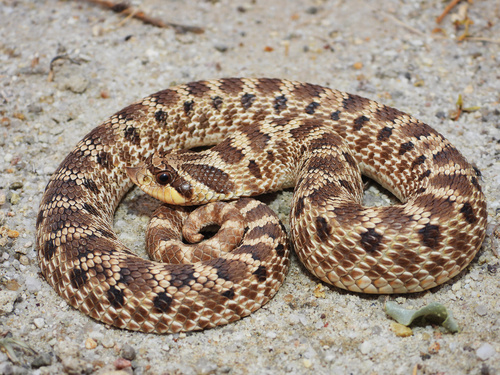
About Heterodon kennerlyi Kennicott, 1860
Heterodon kennerlyi, first described by Kennicott in 1860, has 2–6 small azygous scales located behind its rostral scale. For adult individuals, the typical snout-to-vent length (SVL) ranges from 15 to 25 inches, which equals 38 to 64 centimeters. The maximum snout-to-vent length ever recorded for this species is 29.9 inches, or 76 centimeters. Its geographic range covers portions of both the United States and Mexico. In the United States, it occurs in southern Arizona, southern New Mexico, and southwestern Texas. In Mexico, it can be found across the states of Aguascalientes, Chihuahua, Coahuila, Durango, Jalisco, Nuevo León, San Luis Potosí, Sonora, Tamaulipas, and Zacatecas. This species reproduces via oviparity, meaning it lays eggs.