About Heteranthera dubia (Jacq.) MacMill.
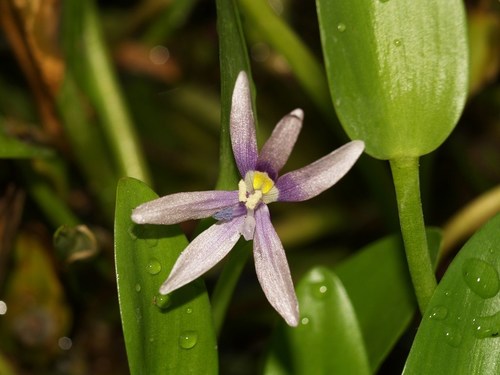
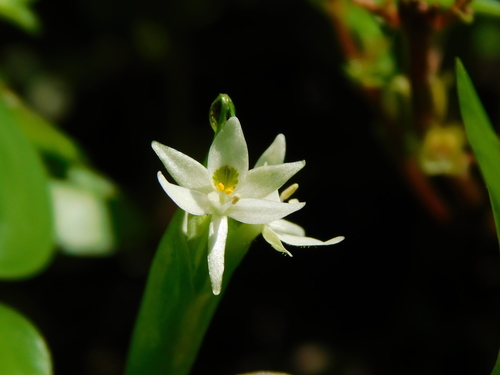
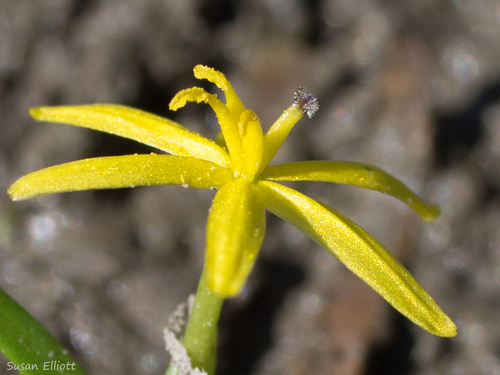
Heteranthera dubia, commonly known as water stargrass or grassleaf mudplantain, is an aquatic plant species belonging to the pickerel-weed family Pontederiaceae. It is native to North and Central America, where it has a widespread distribution ranging from Canada to Guatemala. This species grows submerged in freshwater environments including rivers and lakes. It can grow in water as deep as 5.5 meters, and also occurs in shallower areas where it may become stranded on shorelines. It reaches its highest abundance in alkaline waters. Heteranthera dubia is a perennial plant that displays a great deal of variation in appearance. Leaf size and shape differ between individual plants, a difference that comes from both genetic variation and responses to local water conditions, such as the speed and turbulence of surrounding water currents. Submerged individuals also have different stem and leaf structures compared to individuals that grow partially or completely out of water. Its inflorescence produces a single short-lived flower: this flower blooms in the morning and wilts by the evening. The flower has six yellow perianth parts, each less than one centimeter long, that spread outward from a tubular throat that measures between one and seven centimeters long. It also has three long, thick yellow stamens with curling anthers, and one yellow style. The fruit produced is a capsule that holds many winged seeds. Parasitic fungus Membranosorus heterantherae sometimes causes galls to form in the tissue of this plant.