About Hesperoyucca whipplei (Torr.) Trel.
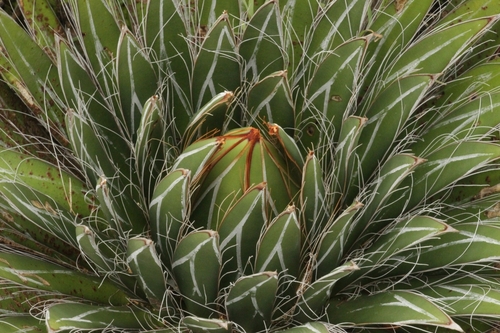
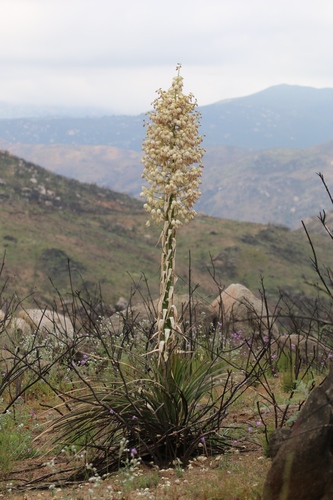
Hesperoyucca whipplei (Torr.) Trel. forms a stemless cluster of long, rigid, gray-green leaves that end in a sharp point. Leaves typically measure 20–90 cm (8–35 in) long, rarely reaching 125 cm (49 in), and 0.7–2 cm (1⁄4–3⁄4 in) wide, with finely saw-toothed edges. A single extremely fast-growing inflorescence reaches 0.9–3 metres (3–10 ft) tall, and can grow up to 25 cm (9.8 in) per day per Guinness World Records, eventually reaching a maximum height of 3.65 m (12.0 ft). The inflorescence bears hundreds of elliptical, bell-shaped white to purplish flowers 3 cm (1+1⁄4 in) in diameter, arranged on a densely branched panicle up to 70 cm (28 in) broad that covers the upper half of the inflorescence. Its fruit is a dry, winged capsule that splits open at maturity to release seeds. The plant takes several, usually more than five, years to reach maturity and flower, blooming from April to May before dying. Most subspecies produce offshoots from the base, so while the parent plant dies after flowering, a cluster of clones around the base continues growing and reproducing. It can also regrow from its base after most of its foliage is scorched by wildfires, which are common in its native range. This species is native to southern California in the United States and Baja California in Mexico, where it occurs mainly in chaparral, coastal sage scrub, and oak woodland plant communities at altitudes of 0–2,500 metres (8,200 feet). Hesperoyucca whipplei is pollinated exclusively by the California yucca moth (Tegeticula maculata), a relationship that is a classic example of mutualism. The female yucca moth collects up to a dozen pollen sacks called pollinia and forms them into a large ball. It then flies to another plant, lands on the ovary of a flower, and stands with its head near the stigma. The moth inserts its ovipositor into the ovary wall to lay a single egg, then rubs its pollen mass against the central stigmatic depression to ensure pollination. The pollinated ovary produces many seeds, which act as a food supply for the moth larva. This species is used in xeriscaping in Southern California, but is reportedly difficult to grow outside its native range, though it is widely available from specialist nurseries in the United Kingdom. It is extremely drought tolerant and thrives in clay soils. Native Americans in the Southwest cultural region used this species extensively as a fiber and food source prior to European settlement, with archaeological evidence of yucca use dating back approximately 5,000 years, including use by the Serrano people of the San Bernardino and San Gabriel Mountains in Southern California. The Serrano harvested the plant hearts during the spring growing season, before the flower stalk was fully developed, as the hearts store sugars needed for rapid stalk growth and become bitter as the stalk matures. Harvested hearts were roasted for several hours in stone-lined earth ovens in a method similar to agave preparation, then cooled to eat; uneaten portions could be dried for storage. The stalks and flowers can also be harvested for food: stalks are prepared the same way as hearts, while petals are often parboiled, even though they have a slight bitter taste. The long leaves of Hesperoyucca whipplei contain strong fibers that can be exposed by pounding and scraping to create long threads running the full length of the leaf. Processing methods to remove outer leaf material include heating green leaves over coals or flame to remove saponins and make scraping easier, boiling or pit roasting live leaves before scraping, and pounding or soaking dry leaves to expose fibers. Shell or stone scrapers were typically used to remove outer leaf material, after which the fibers were soaked in water to soften them. The processed fibers were twisted into cordage, used as material for baskets, or woven into sandals. Other yucca species were also used by groups across the American Southwest: archaeological evidence from 5,000 years ago documents use of Yucca shidigera (Mojave yucca) near the Mexico-United States border, yucca residues found on stone tools in a Texas cave show yucca was used to secure stone tools to other materials, and ethnographic evidence notes the Mogollon people wove whole fire-heated green yucca leaves (with only the tip spine removed) into the base of sandals, secured with cordage ties.